Suburban office trades near a 10 cap while retail and industrial compress to six and seven. Tanh Truong on why half-empty office in Blue Ash is the one Cincinnati asset class where basis is still negotiable.
Suburban office in Blue Ash, Kenwood, and Montgomery runs around 85% occupied. Drop into a C-class pocket like Silverton and the same asset class sits at 50% or less. That spread is where non-residential commercial value sits in Greater Cincinnati right now, and it is why an investor controlling over $50 million in retail, office, and industrial buys inside the 275 loop and stays out of the urban core.
About This Post
This analysis draws from a conversation with
Tanh Truong of Invest Beyond Multifamily, a lifelong Cincinnatian who came up through residential wholesaling, flipping, and buy-and-hold before moving into non-residential commercial. His firm controls over $50 million in retail, office, and industrial assets and runs an accredited fund, with much of that activity in the Cincinnati MSA.
Listen to the full conversation on
Spotify,
Apple Podcasts, and
YouTube. The full episode also includes a live screen-share walkthrough of active Cincinnati listings and how he screens them in under a minute each.
The Cincy REI Show publishes every Monday. New episodes cover neighborhood-level analysis, local investor strategies, and real deal stories from operators active in Greater Cincinnati.
Where Office, Retail, and Industrial Deals Sit in Greater Cincinnati
The screening starts with the terrain view of the map rather than the road view, because rooflines show where commercial development already sits. Everything worth buying clusters within about 15 minutes of the 275 loop.
- Blue Ash, Sharonville, Montgomery, and Kenwood are the office targets. Occupancy in the better buildings runs near 85%, and these submarkets sit directly in the path of commercial development along the loop.
- Downtown and the CBD are avoided outright. Parking is difficult, and office there took the worst of the post-COVID damage with little recovery since.
- Silverton and comparable C-class pockets run 50% occupancy or less in office, with limited inventory to begin with.
- Fairfield along Route 4 and Dixie Highway carries roughly 40,000 vehicles per day, a signalized intersection, national fast food, and Jungle Jim's as a regional draw. The city's economic development department is openly pro-business.
- Lockland works for industrial because of its proximity to I-75. It does not work for retail or office.
- Harrison Avenue on the west side is seeing real activity, including Dunkin', hotels, restaurants, and a Kroger relocation, in an area that runs C-class through Cheviot and improves toward Bridgetown.
- Reading and Mason round out the retail list, with a preference for strip centers carrying three or more units.
- Middletown stalled for years behind a city council that fought internally and was not business friendly, though reports on that are improving.
Industrial follows the arteries instead. I-75 matters most, then I-71, then I-74, with I-275 serving circulation rather than intercity freight. State routes 28 toward Goshen, 32, US 50, and US 52 all support industrial demand, as does proximity to the airport.
Suburban Office Is Repricing While Retail and Industrial Compress
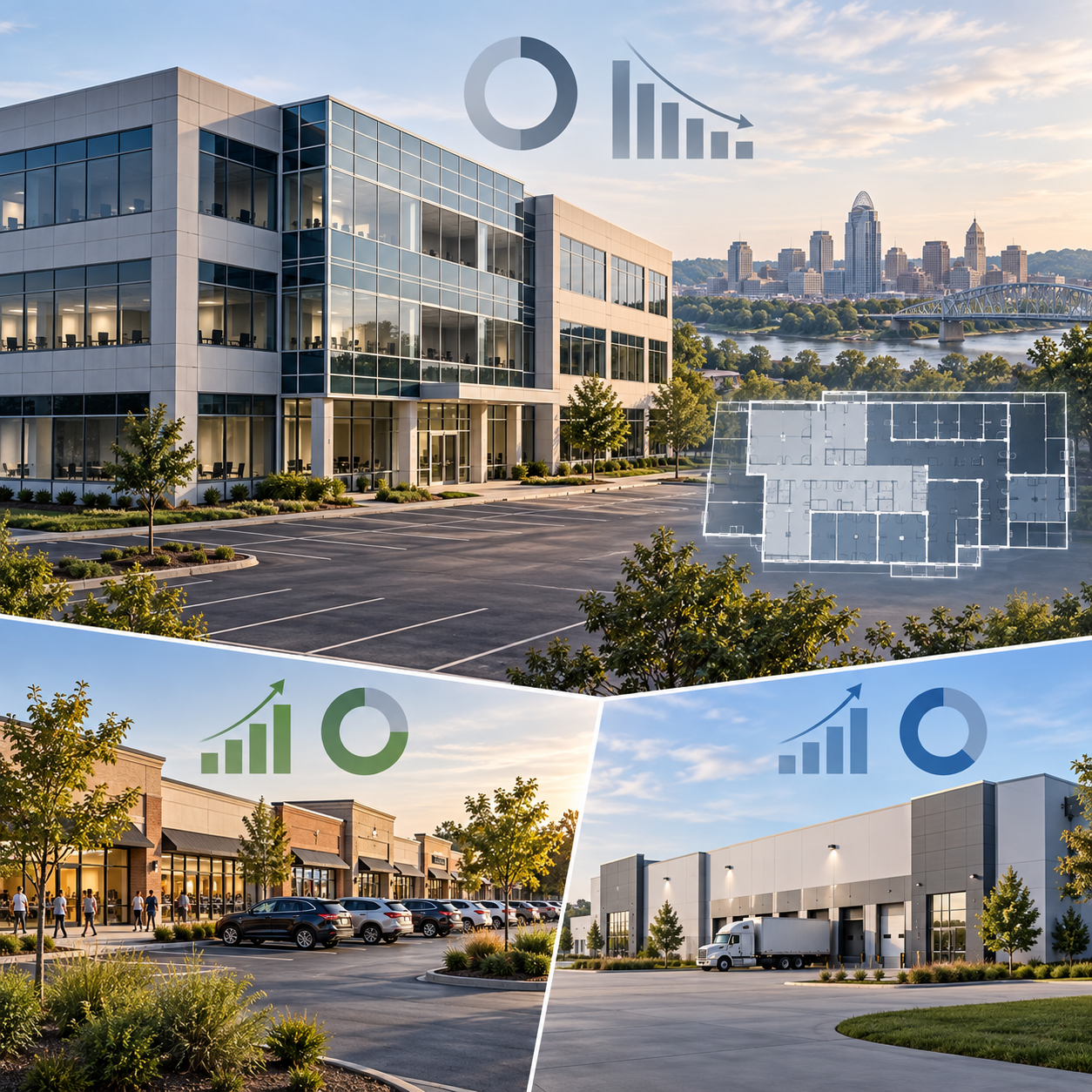
Three asset classes in the same MSA are priced on three different curves right now.
What's Working in Cincinnati
Price per square foot is the fastest filter. Normal build cost in this market runs $150 to $200 per square foot, and custom runs $250 to $400, so anything above $200 gets skipped and anything under $150 gets a second look. Deals still under $100 per square foot exist here.
What is not working: filtering LoopNet or Crexi by cap rate, since those numbers come from broker pro formas rather than actuals, and buying a fully leased center at a seven cap with no vacancy, no below-market leases, and no excess land, which is parking money rather than investing it.
Lessons From the Field: How One Fairfield Strip Center Produced Three Wins
The center sits a mile and a half up Dixie Highway, on a signalized intersection carrying about 40,000 vehicles per day, next to a McDonald's and a Wendy's. Those two do their own site research before they build, which makes them free validation of the location. Inside the center, a Dollar Tree and later an O'Reilly's drew the traffic that kept the smaller tenants full.
- Underwrite the neighbors before the building. A national brand next door has already paid for the site study, and their presence prices into your leasability.
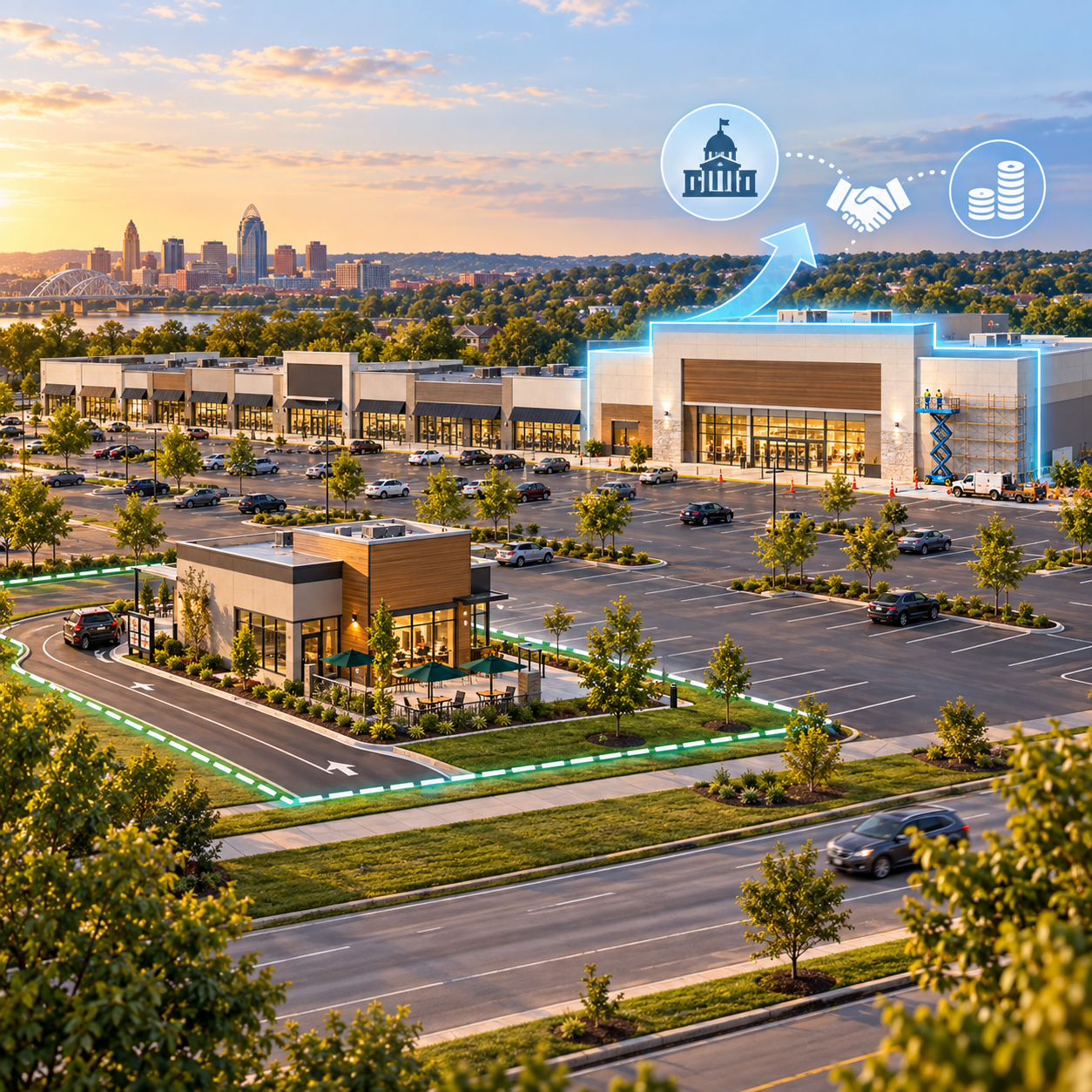
- Look for the land nobody is using. Excess parking or frontage can be parceled out and sold, ground leased, or built on, which resets the basis on the center behind it.
- Call the economic development department early. Sitting in on a city council meeting shows whether the body is unified, and a unified council approves things a fractured one will not.
- Signalized traffic is a real underwriting input. Cars that stop see the storefront, which is why counts and signage rank alongside rent roll on retail.