
The Sun Belt absorbed the largest wave of new apartment supply since the 1970s over the last three years. Rent growth went flat to negative. Population growth never stopped, and more people are still moving to the Sun Belt than to the Midwest, so the problem was supply outrunning demand rather than demand disappearing. Rent growth is projected to resume next year depending on the submarket. The recovery signal is on the building side: cheap debt made construction projects pencil, which produced the flood, and expensive debt stopped projects from penciling, which turned the tap off.
Why Cincinnati Multifamily Avoided the 2021 Cap Rate Trap
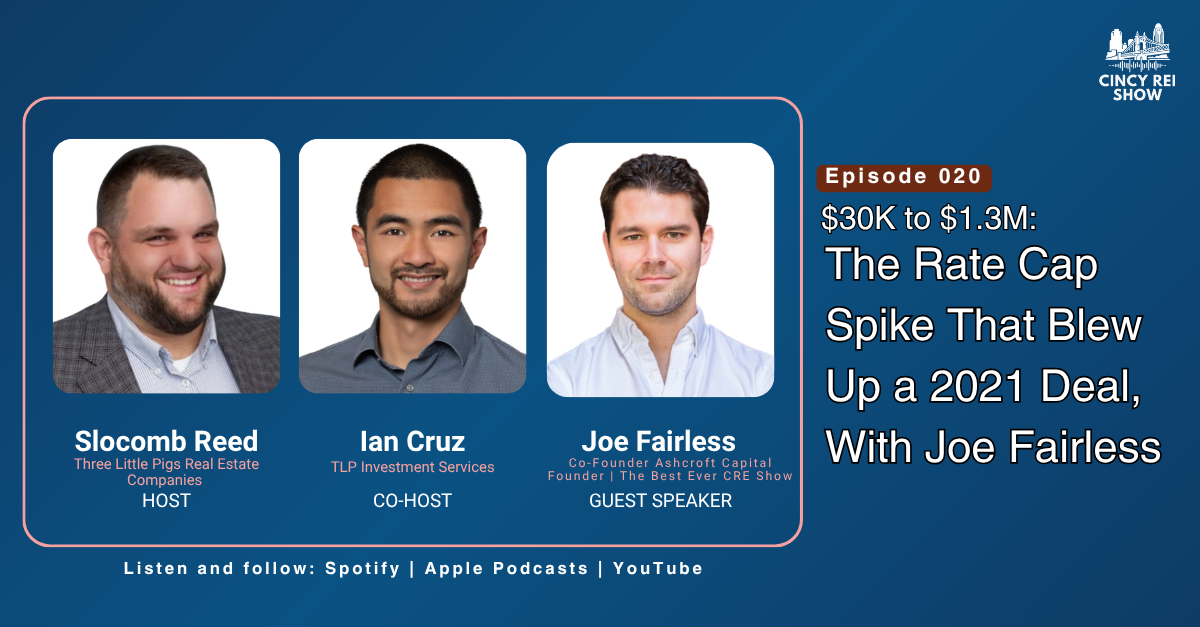
A rate cap that cost $30,000 renewed at $1.3 million. Joe Fairless on the first two losing sales in Ashcroft Capital's history and why Greater Cincinnati never had the spread to lose.
A rate cap that cost $30,000 at purchase came back at $1.3 million on renewal. That single line item helped push Ashcroft Capital into the first two losing sales in its history, in October and November of last year, after 26 profitable exits between 2015 and 2021. Joe Fairless walked a room of Cincinnati operators through what actually broke 2021-vintage multifamily, and why Greater Cincinnati never had the same math to lose.
About This Post
This analysis draws from a conversation with Joe Fairless, co-founder of Ashcroft Capital and founder of Best Ever CRE. Fairless started the Cincinnati mastermind this show records at 11 years ago and hosts the longest running daily real estate investing podcast. Ashcroft has run a full cycle: buying since 2015, 26 profitable exits through 2021, billions in assets under management, and the first two losses in the firm's history last year, which makes his read on 2021-vintage distress firsthand rather than secondhand.
Listen to the full conversation on Spotify, Apple Podcasts, and YouTube. The full episode also covers lender flexibility on maturing loans, the Best Ever Inner Circle, and live Q&A from Cincinnati operators in the room.
The Cincy REI Show publishes every Monday. New episodes cover neighborhood-level analysis, local investor strategies, and real deal stories from operators active in Greater Cincinnati.
Where Greater Cincinnati Sits While the Sun Belt Resets
Ashcroft's entire portfolio sits in the Sun Belt: Texas, Florida, Georgia, and North Carolina. Fairless lives in Cincinnati, started this meetup 11 years ago, and made his early mistakes in the Greater Cincinnati market before moving his buying south in 2015. Two regions, the same interest rate environment, very different outcomes.


The Midwest stayed slow and steady, with positive rent growth through the same stretch. That is the difference between an operator with options and an operator with a maturity problem. Growing NOI creates flexibility. Flat NOI paired with expanded cap rates is where deals break.
The Cincinnati metro is adding supply at roughly the pace of population growth, which runs 1% to 2% a year. What does get built is Class A and amenitized, priced well above the neighboring stock, so it competes with almost nothing in the existing inventory. The region's largest multifamily boom was in the 1960s, and those brick four-family and 12-family buildings are still the backbone of the market. What looks like a 72-unit deal is often six 12-unit buildings. That architecture has not changed since, no one is building more of it, and institutional buyers have no interest in it, which leaves it to operators buying at higher cap rates

Florence, Kentucky produced the counterexample in the room. A Northern Kentucky property bought in 2021, the exact vintage generating national loss headlines, recently sold as a strong investment for its investors.
Orlando shows what disciplined Sun Belt buying looks like now. Ashcroft bought a 315-unit, 2021-construction property in August 2024 at a 5.5 cap with fixed-rate debt and roughly three years left on the hold. Cap rates on that asset have since compressed to 4.8.
Why Cincinnati's Cap Rate Spread Absorbed the Rate Shock
The math that broke 2021 Sun Belt deals is straightforward. Buyers paid cap rates around 3.5%. Interest rates rose, cap rates followed to roughly 5.5%, and values fell. Add floating-rate debt and a supply wave that stalled NOI growth, and the pro forma stops working. That was a perfect storm running from 2021 through 2024.

Greater Cincinnati never had that spread to lose. Interest rates have moved into the sixes and sevens, with some assets and borrowers pushing into the low eights. Those rates landed roughly where Cincinnati cap rates already were. Nobody here bought a 3 cap and then had to carry 7% debt against it. There is more cash flow per dollar of value in this market, which is why the region has produced far fewer distressed sellers, and also far fewer screaming deals.
Two other conditions shape the Cincinnati real estate opportunity set right now. The buyer pool is thin, with fewer active players than there were three years ago, which matters more to an operator with capital and operational capacity than headline pricing does. And capital raising got harder everywhere: syndication carries more stigma than it did five or six years ago, multifamily capital raising is down across the industry, and the same raise now takes more conversations. Fairless's answer on handling that was to listen and answer investor questions directly, and to double down on operations, which is the part an operator actually controls.
The exposure line is worth naming precisely. Anything above four units is commercial debt, and commercial loan terms are what created this cycle's distress. A 10, 12, or 20-unit building may carry different financing, and the outcome depends far more on when the property was purchased than on how large it is.
What's Working in Cincinnati
Class C operational value-add is the clearest opportunity in this market. You can buy at a 7 cap on actuals, meaning on what the property is producing today, and still have real revenue upside because rents sit below market and the previous owner was never good at filling units or collecting rent.
- The operational gap is measurable before you close. A portfolio generating $50,000 to $55,000 a month in revenue can reach $70,000 a month without significant capital improvements. Treat tenants well. Fix things when they break. That is $15,000 a month generated by operating better than the predecessor did.
- Grade by vintage, not by the textbook A/B/C definitions. In Cincinnati, brick bunker construction from the late 1940s through 1978 is Class C: boilers converted into electric baseboards that are uncomfortable to live with, and floor plans that have not aged well. After 1978 it starts to feel like Class B, because mechanicals improved, code improved, and floor plans moved toward central heat and central air.
- Expect a heavier operational lift, and staff for it. The revenue upside in Class C is earned through management, not through a capital budget. It requires an owner who actually wants to run a property.
- Know that Class C has no national buyer market right now. Fairless said nobody knows when the bottom drops for Class C, and Ashcroft would not buy it today. He believes the bottom has already dropped for Class B, which still carries value-add, and he is confident in Class A, which is why institutions are chasing Class A deals that will always trade. Cincinnati cap rates for Class C have not moved much. Less competition is the opportunity. It is also the reason to tread carefully.
- If you buy stabilized, buy location. Returns on already-performing product are lower than they were, and there is no operational upside left to rescue the deal. Buy the best location you can afford and position for natural market rent growth.
What is not working: buying stabilized product and underwriting it to 2018 returns. The deals that pencil in this market are the ones where somebody else's operational failure is the value-add.
Lessons From the Field: When a $30,000 Rate Cap Renews at $1.3 Million
Ashcroft bought in 2021. Cap rates were around 3.5%. The debt was floating rate with a rate cap in place, which is standard structure for that loan type. The cap cost $30,000.

A rate cap limits how high a floating interest rate can go, and it expires. When rates rise, the cost of replacing that cap rises with them, exponentially, the further below market the original rate was. The renewal on that deal came in at $1.3 million.
Three other things moved against the deal at the same time. Cap rates expanded from 3.5% to 5.5%. NOI did not grow, because Sun Belt rent growth was flat to negative. And the five-year loan from 2021 matured in 2026.
The property was worth close to or less than the debt against it, and no lender was going to write a new loan at the old valuation. That left two options: recapitalize by injecting new equity so the next loan is smaller, or sell at a loss. Ashcroft did not have confidence the property would appreciate enough to return the new money a recapitalization would require.
They sold. Two deals, October and November, the first losses after 26 profitable exits, and Fairless expects other 2021-vintage deals to sell at a loss as well. A longer fixed-rate term would have bought time, though the reckoning still arrives unless cap rates compress or NOI grows.
- Price the rate cap renewal, not the rate cap. What a cap costs at closing tells you nothing about what it costs to replace three years later. Model the renewal at rates well above where you bought.
- Loan term is the real risk control. A maturing five-year loan removed every option except recapitalize or sell. Time is the asset that lets a cycle work itself out.
- You need cap rates or NOI moving your way. When cap rates expand and NOI stays flat at the same time, the loan term decides the outcome.
- Know your lender's balance sheet before you need it. Portfolio lenders, meaning small banks and credit unions that keep the loan on their own books, can work with a borrower in ways a lender answering to outside investors cannot. That advantage carries from single-family into large commercial.
- Separate the constants from the variables. Nobody knows where interest rates go in two years. Supply is more knowable: cheap debt produced the building wave, expensive debt stopped it, and the negative rent growth that followed should dissipate as that supply gets absorbed.

Houses that sold for $30,000 in Madisonville now trade at $125,000 to $150,000 still needing full renovations. A property manager with 700-plus units on where the next wave is going, and why the 12-unit building is the target.

Suburban office trades near a 10 cap while retail and industrial compress to six and seven. Tanh Truong on why half-empty office in Blue Ash is the one Cincinnati asset class where basis is still negotiable.

$1,900 in Winton Woods, $1,643 in Oak Hills, same bedroom count. What a 100-plus unit portfolio across nine districts reveals about which Cincinnati houses should stay rentals and which should be sold.

The renovation ran 2.5x over budget and produced 3x the rent bump. John Casmon on the Boone County data behind an 81-unit Florence buy, and the census-tract tool he uses instead of radius reports.

Cincinnati built almost no new apartments for 24 years. Gil Richards on the abatement math, which buildings qualify for historic credits, and why downtown is formally classified as Difficult to Develop.
Section 8 in Cincinnati: Why CMHA and Butler Metro Produce Different Returns

A $180,000 all-in flip selling for just under $270,000, with no cash out of pocket. Slocomb Reed breaks down four Greater Cincinnati deals, and why none of them depended on the market going up.

West Newport houses sold for $10,000 in 2016 and now go for $80,000 needing full rehabs. Garth Kukla on why proximity to a walkable corridor predicts Northern Kentucky value better than which city a property sits in.

The Hamilton County timeline from a missed rent payment to a set-out; and why TLP's Izzy Ong treats every case that reaches a magistrate as a failure of the process, not a win.

A $450,000 Loveland listing sold for $570,000 cash. Ethan Bishop on which Greater Cincinnati submarkets are drawing multiple offers, which have quietly cooled, and the two-generation demand pattern driving both.