Cincinnati built almost no new apartments for 24 years. Gil Richards on the abatement math, which buildings qualify for historic credits, and why downtown is formally classified as Difficult to Develop.
Cincinnati went roughly 24 years without meaningful new apartment development, and the incentive structures built to end that drought are still what makes most urban core projects pencil. This post covers which properties qualify for historic tax credits, how the property tax abatement actually calculates, what Connected Communities changed for smaller developers, and why downtown is classified as difficult to develop.
About This Post
This analysis draws from a conversation with
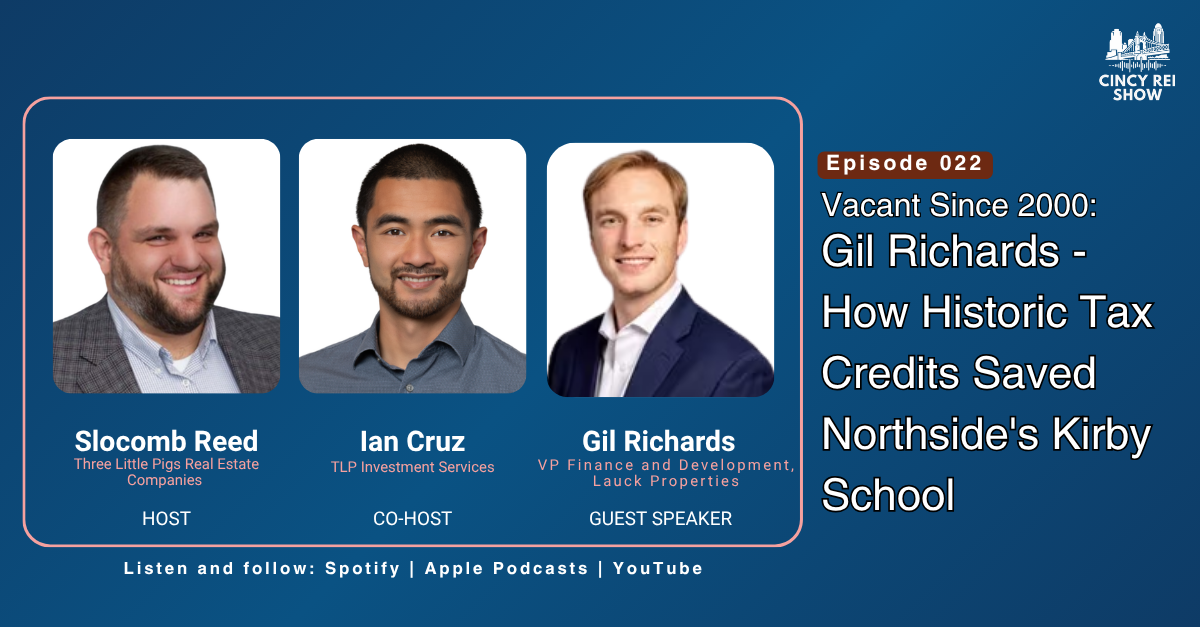
Gil Richards, VP of Finance and Development at Lauk Properties, which controls $55 million in Greater Cincinnati real estate across multifamily, industrial, and retail. Richards spent his first years in the market as a multifamily broker starting in January 2020, which gave him a fast read on portfolios, pricing, and capital stacks across the region.
Listen to the full conversation on
Spotify,
Apple Podcasts, and
YouTube. The full episode also covers whether a real estate finance degree is worth it, the downtown residential zoning quirk that creates office condos, and Richards' Cincinnati hidden gems.
The Cincy REI Show publishes every Monday. New episodes cover neighborhood-level analysis, local investor strategies, and real deal stories from operators active in Greater Cincinnati.
Downtown, Over-the-Rhine, and Northside: What Changed Since 2020
Richards points to downtown as the part of Greater Cincinnati that has changed most since the start of 2020, and the reasons are structural rather than cyclical.
- The Central Business District is small and dense. Below the CBD line it runs roughly 12 blocks by 16 blocks, and nearly every parcel is either already accounted for or historically protected. Two quasi-public players shape what gets built: 3CDC and the Port Authority, which most out-of-market investors never think of as a real estate developer. Two bonded sewers run as conduits that have facilitated a large share of the private development downtown. More CBD office buildings are now converting to apartments.
- Over-the-Rhine carries the clearest headwind in the urban core. The 15-year tax abatements from the first wave of 3CDC-era condo conversions are expiring, and those property tax bills are climbing sharply. Values have stayed high and stopped moving, and residential property there has become harder to sell. Development continues in the parts of OTR that did not get built out during the first cycle 10 or 12 years ago.
- The Banks keeps producing announcements. New projects surface there on what feels like a rolling basis, and the redevelopment has not slowed.
- Northside works on a different logic. Richards describes it as a real community where people care what happens there, which is what makes the neighborhood work. Lauk owns the Kirby School there, a 1910 building rebuilt through historic tax credits.
- Hamilton County carries a millage rate Richards calls out plainly. Hamilton, Cuyahoga, and Franklin counties sit among the highest property tax counties in the country, and that is a line item every Greater Cincinnati underwrite has to survive.
Downtown residential demand has returned since the pandemic dip, when close quarters pushed people away from OTR specifically. The exception is the abatement expiration wave, which is a tax problem rather than a demand problem.
Why Downtown Cincinnati Doesn't Pencil Without Public Money
Richards is direct about what that means in practice. Nobody has built a true market rate project downtown on a simple tax abatement application alone. The capital stacks that work carry more:
- TIF financing on top of a standard CRA designation. The abatement by itself does not close the gap.
- A subordinate ground lease with the Port Authority, structured to carry the project through construction and reduce property tax exposure during that window.
- State historic tax credits, which Cincinnati has drawn an outsized share of and which were critical to the revitalization of both downtown and Over-the-Rhine.
Two more constraints shape what gets built. Downtown development cannot be 100% residential, which forces developers to carve commercial square footage out of buildings where the same footage would be worth roughly three times as much as apartments or condos. And parking remains a demand-side requirement even where it is no longer a zoning requirement. Cincinnati is not a metro where residents treat a car as optional, so market rate residential downtown carries the construction cost of parking whether or not code demands it.
The practical takeaway for an investor sizing up a downtown deal is that the capital stack is the project. Rents set the ceiling, and in this submarket that ceiling sits below construction cost. Everything that gets built downtown closes the gap with public participation of some kind, so the question to answer early is which programs a specific building qualifies for.
What's Working in Cincinnati
The two incentive programs most Cincinnati real estate investors should understand are the property tax abatement and the historic tax credit. They serve different investors and carry very different levels of difficulty.
The property tax abatement is the accessible one. Richards recommends it for anyone doing substantial rehab or new construction, and the process for buildings under four families is streamlined.
- You have to pull permits. The abatement runs on submitted receipts, and receipts mean permitted work. Richards' point on the building department is that it is not the adversary investors assume it is.
- The term lands between eight and 12 years. That range is the sweet spot for what to expect.
- The benefit is net 50% of the incremental value of the improvements on the residential side for the larger items, measured against what the property was taxed on before abatement.
- The resale multiple is where it pays off. Abated taxes carry a significant value multiple when you sell, which is the part investors doing a rehab for hold often fail to price in.
The city's logic is a straight trade. Pull permits for the mechanicals, the roof, and the other hard costs that show up in an appraisal, and pay less tax. In exchange the city gets oversight, which matters because a seller's claim that work was done is not the same as work having been done correctly behind the walls.
Historic tax credits are a heavier lift and Richards steers first-time developers away from them. The qualification path:
Connected Communities is the third piece, and it is the one that lowered the barrier for smaller operators. It is not the comprehensive plan. It is the city relaxing constraints on housing development: looser setbacks, more streamlined permits, a significant relaxation of parking requirements, and an emphasis on transit. The targeting logic is infill where water and sewer already exist, because tapping existing lines is the cheapest place to add units in an old Midwestern city. Richards estimates it has cut roughly 20% off the initial entitlement timeline. Fewer barriers means more first-time and second-time developers entering the market.
The suburbs run their own version of this. Reading passed a Community Reinvestment Area abatement covering its entire valley, which is unusual municipal cooperation for a small Hamilton County city and is doing real work on the development there. That case is covered in
Reading, Ohio: Cincinnati's Unlikely Development Hotspot.
What does not work is assuming a downtown deal pencils on rents alone. Richards' whole point about the DDA classification is that the rent side has already been tested and found insufficient.
Lessons From the Field: How a Vacant 1910 Northside School Got Rebuilt
The Kirby School in Northside was built in 1910 and sat vacant from roughly 2000 onward.
Around 2011 or 2012, the city of Cincinnati was carrying a large inventory of vacant schools and other real estate that cost money to hold. Following the Great Recession, the city auctioned much of it off to shed expenses, generate revenue, and push development. Kirby was one of those auctions.
A local architecture and development firm bought it and partnered with the Cincinnati Development Fund. They got the building registered as historic and applied through the state for tax credits, and that credit became the major piece of the capital stack.
The reason it had to be is the rent. Rents at the building were running around $1 per square foot at the time. Set that against new mechanicals and everything else a 100-year-old vacant school requires and the math does not work. There was an abatement on the project as well. Without the credit, the building does not get repurposed.
Lauk Properties purchased it after the redevelopment was complete.
4 things this project shows about incentive-driven deals in Greater Cincinnati:
This is paragraph text. Click it or hit the Manage Text button to change the font, color, size, format, and more. To set up site-wide paragraph and title styles, go to Site Theme.