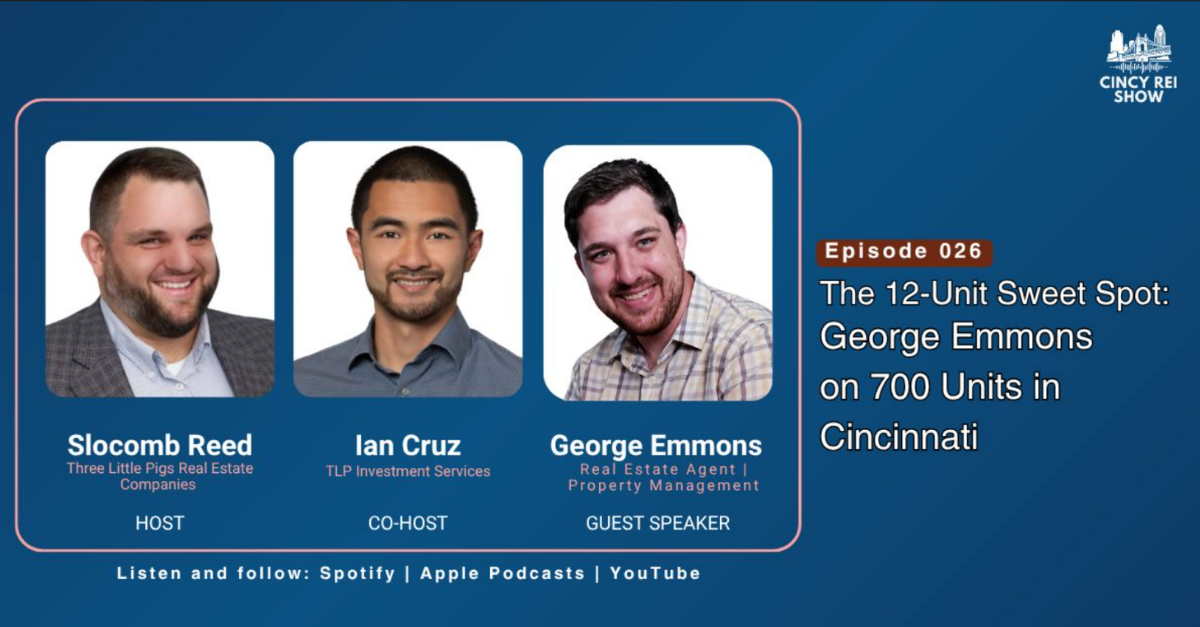
Houses that sold for $30,000 in Madisonville now trade at $125,000 to $150,000 still needing full renovations. A property manager with 700-plus units on where the next wave is going, and why the 12-unit building is the target.
Ten years ago, investors bought houses in Madisonville for $30,000 to $40,000. Today those same houses, still needing $50,000 to $70,000 in renovations, trade at $125,000 to $150,000 on the low end. The source is a property manager overseeing more than 700 units across Greater Cincinnati, mostly east side multifamily from Milford to Northside, with a working view of rents, lease-ups, and code enforcement before the listing data shows it.
About This Post
This analysis draws from a conversation with
George Emmons, property manager and investor with Keller Williams Seven Hills Realty. Emmons and his father have managed and invested on the east side since 2008, and his team now manages more than 700 units, from a 115-unit independent living facility in Milford to quads in nearly every neighborhood.
Listen to the full conversation on
Spotify,
Apple Podcasts, and
YouTube. The full episode also covers how the family business grew from one building into a management company, and Slocomb Reed's approach to contesting City of Cincinnati violation notices.
The Cincy REI Show publishes every Monday. New episodes cover neighborhood-level analysis, local investor strategies, and real deal stories from operators active in Greater Cincinnati.
Where Cincinnati Investors Are Buying After Madisonville Repriced
- Madisonville hit critical mass around 10 years ago, when mixed-use retail with apartments above went up along Madison Road. Deals still exist, but buyers now pay a premium over neighborhoods that have not crossed that line.
- Over-the-Rhine followed the same path 20 years ago, when 3CDC and later Model Group bought and developed large sections at once.
- Carthage still has $40,000 to $50,000 houses and a strong Hispanic community along Vine Street. The upside is real, and it is a 10-year hold.
- Norwood has a long rental track record, and Factory 52 already shifted its rental landscape. A planned development near Harris Avenue, north of Factory 52 and south of the Norwood Lateral, stalled during COVID. If it restarts, parts of Norwood could move faster than Carthage.
- St. Bernard leases up quickly. It sits just east of Exit 6 on I-75, near the Lateral, and one neighborhood up from the zoo, the hospitals, and UC. The stock is Cape Cods, early 1900s duplexes and three-families, and 1950s to 1970s fourplexes and 12-units. The largest building seen trading there was 17 units, and the city resists added density, so subdividing is hard.
- Milford, Loveland, and Lebanon keep growing around walkable old-school downtowns. Home values in old downtown Milford nearly quadrupled in 10 years.
- Goshen, Amelia, and Withamsville absorb buyers priced out of Milford and Loveland. The developable acreage is here, alongside 1940s to 1960s ranches and split levels that command a rent premium from school district demand.
Price-Outs, Walkable Downtowns, and Code Enforcement Are Reshaping Cincinnati Deals
The third shift is regulatory. St. Bernard rolled out a new rental registration program this year, with in-unit fire safety inspections every two years. Inspectors check outlets, egress windows, and bedroom privacy doors. Owners with unpermitted basement units will get caught. Norwood residents already call their city "a big HOA." Enforcement is a revenue driver for cities, and it also protects property values, which benefits owners who maintain their buildings.
What's Working in Cincinnati
For Multifamily Real Estate Investing in 2026, the 12-unit building is the sweet spot. It delivers economy of scale without a $25 million check or a stack of JV Partnerships. The 1960s and 1970s 12-unit vintage appears in nearly every neighborhood, and larger complexes are often multiples of 12.
- Vacancy tolerance. One empty unit in a 12-unit barely dents cash flow. One empty unit in a duplex is half the income.
- Staffing. A maintenance person handling unit turns has enough work to stay with you.
- Value-add supply. Larger Cincinnati complexes have mostly cycled through renovations. Many 12-units have sat in one family for 60 years with no updates in 15 to 20, leaving room for $300 to $500 rent increases and a cash-out refinance.
Valuation is where Real Estate Underwriting and Due Diligence gets difficult. One to four units comp on sales. Forty units and up trade on NOI and cap rate. A 12-unit sits between them. Start with a market rent analysis, find the best-day rent and the worst-day rent, and underwrite close to the worst day. If top-dollar rent in the area is $900, a deal that needs $1,050 will never support the valuation.
Rookie investors most often miss renovation numbers and big-ticket hidden capex, such as crushed gutter drain lines that require excavation. On a single-family house, one of those problems can sink the project. Across 12 units, it hurts without killing the deal.
Lessons From the Field: When Code Enforcement Sets the Timeline
A CMHA tenant had lived in one Norwood house for more than 15 years. She passed away after health issues. Her family took over the house, could not handle the cleanup, and left belongings on the sidewalk without telling anyone.
That pile exposed the owner to a $500 trash fine if a neighbor called it in. Clearing the house required a dumpster permit, and Naorwood quoted three to four days for an inspector to confirm the placement area.
The decision was to send an extra crew immediately to move everything off the sidewalk and stage it in the side yard until the dumpster arrived.
Slocomb Reed saw the other side of enforcement in the City of Cincinnati. Two violations in Roselawn and Westwood cited belongings blocking the sidewalk, when the items sat in the grass strip between the sidewalk and the road. His team cleared both sites within hours, contested both notices, and had both fines dismissed because the inspector wrote the wrong violation.
- Know each municipality's permit timeline before you need it. A three-to-four-day dumpster approval in Norwood can leave a sidewalk pile exposed to fines for days.
- Clear first, then argue. Removing items within hours limits the fine and strengthens any appeal.
- Read the violation as written. A citation for the wrong condition can be contested at a hearing.
- Budget compliance into every Norwood and St. Bernard deal. Inspections, permits, and fines belong in the underwriting.
- Scale absorbs surprises. A long-tenured tenant's turnover, a fine, and a cleanout hit a single-family owner far harder than a 12-unit owner.