Bret Halsey went from pro soccer to 70-plus units in under three years, 14 of them fourplexes. How Cincinnati's repeating 1960s floor plans make the city's most common multifamily building the easiest one to underwrite.
Bret Halsey went from playing professional soccer for FC Cincinnati to owning over 70 units in under three years, 14 of them fourplexes, almost entirely sourced through his own cold calling. His path into the market started with a single four-family in
Pleasant Ridge, and it turned into a repeatable formula for identifying, financing, and flipping Cincinnati's most common multifamily property type: the 1960s brick bunker fourplex.
About This Post
This analysis draws from a conversation with
Bret Halsey, a former professional soccer player turned full-time real estate investor who has acquired over 70 units across Greater Cincinnati, primarily through direct-to-seller cold calling. Halsey's rapid transition from house hacker to active operator, sourcing nearly every deal himself, gives him unusually granular, hands-on knowledge of how Cincinnati's fourplex stock actually trades and renovates.
Listen to the full conversation on
Spotify,
Apple Podcasts, and
YouTube. The full episode also covers Halsey's cold calling routine in detail and a story about a tenant-caused explosion that leveled one of his Price Hill fourplexes.
The Cincy REI Show publishes every Monday. New episodes cover neighborhood-level analysis, local investor strategies, and real deal stories from operators active in Greater Cincinnati.
Where Fourplex Investing Works Across Greater Cincinnati
- Pleasant Ridge is where Halsey bought his first fourplex as an owner-occupant in September 2023, chosen partly for its proximity to his soccer training facility in Milford and partly because it hit the 1% rule with central heat and air already in place. Halsey specifically targeted this neighborhood, along with
Silverton and
Deer Park, as a middle ground between overpriced Oakley and Hyde Park and less desirable areas further out, describing it as sitting in the path of Oakley's gentrification spilling outward.
- Oakley and Hyde Park are effectively priced out of fourplex cash flow for Halsey's model. A comparable four-unit in Hyde Park runs around $750,000 and does not cash flow at all, with Oakley only marginally better.
- Norwood produced Halsey's first deal, a 45-unit property he found through nine months of cold calling and ultimately wholesaled, generating more profit than his entire year of professional soccer. Norwood also cost him a lesson: he passed on a fourplex on Bosworth Place in Pleasant Ridge priced at $270,000 to $280,000, only to see a comparable property on the same street sell for $410,000 six to nine months later.
- Roselawn is, in Halsey's description, "an interesting street" almost entirely composed of fourplexes, where he has sold multiple properties to a mix of investors and owner-occupants, including one buyer who raised her daughter there.
- Price Hill was Halsey's first West Side purchase, three auctioned fourplexes totaling 12 units bought for around $420,000 with six-month hard money, despite having no prior ownership experience on the West Side. One of those buildings was destroyed in a gas explosion caused by a non-paying tenant in March, a total loss that Halsey's replacement cost value insurance ultimately covered.
- Bond Hill rounds out Halsey's early portfolio alongside his Pleasant Ridge and Norwood holdings, part of the initial 10-to-14-unit base he had built before scaling into larger deals.
Why 1960s Brick Bunker Fourplexes Are So Easy to Underwrite
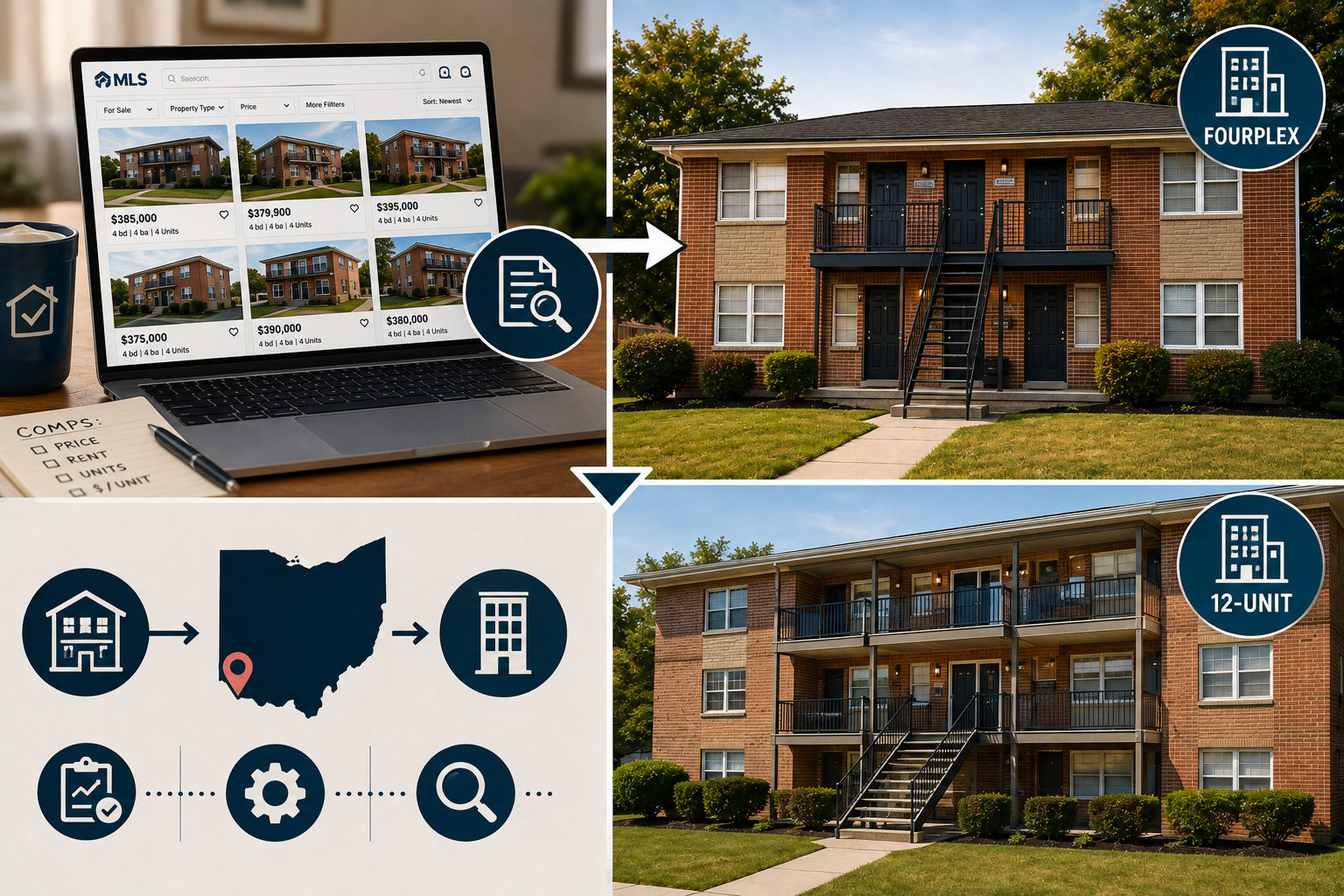
Cincinnati's fourplex stock is remarkably uniform, built primarily in the 1960s (as early as the late 1940s, as late as the mid-1970s) in what Halsey and Slocomb both describe as a small handful of repeating brick-and-block floor plans. Because these are purpose-built multifamily structures rather than converted single-family homes, narrower buildings consistently produce one-bedroom units, while wider ones produce two-bedrooms, a pattern visible from the building's facade alone before ever stepping inside.
What's Working in Cincinnati
Halsey's approach to sourcing and financing fourplexes rests on a few specific, repeatable mechanics.
- Niche down to a specific property type and neighborhood before cold calling at scale. Halsey struggled with unfocused calling until his first mailer-sourced Pleasant Ridge fourplex gave him a concrete anchor point, after which he could quote specific purchase and resale numbers to prospects with real confidence.
- Use hard money and minimal down payment to preserve capital for scaling. Halsey's fourplex strategy relied on financing at or near 100% loan-to-value, sometimes blending 90% hard money with 10% private money, prioritizing equity capture and capital preservation over immediate cash flow.
- Match the exit buyer to the neighborhood. In areas like Pleasant Ridge, Halsey can price a fourplex to attract an owner-occupant buyer willing to pay a premium for residential-style financing, while properties in neighborhoods like Roselawn or on the West Side more often sell to investors. Halsey notes fourplexes can trade for $100,000 to $120,000-plus per unit due to this owner-occupant financing advantage, compared to roughly $80,000 per unit for a 6-to-10-unit building with similar rents.
- Focus renovation dollars on cosmetic upgrades, not mechanical overhauls. Adding a dishwasher, reglazing original tile white, installing butcher block counters or granite depending on the neighborhood, and updating light fixtures and hardware are Halsey's highest-return, lowest-complexity improvements. Projects that strayed into garage doors, foundation work, or unexpected roof and mold remediation were the ones that blew up his budgets.
- Build direct-to-seller relationships with a personal story, not just an investor pitch. Halsey found that leading with his background as a professional athlete, rather than a generic investor cold call, opened doors with property owners who might have otherwise ignored the outreach entirely.
What is not working: expecting significant cash flow from a 100%-leveraged fourplex acquisition strategy. Halsey shifted his own model away from refinancing and holding these properties once he realized his highly leveraged deals were not generating meaningful cash flow, choosing instead to sell and roll proceeds into larger acquisitions.
Lessons From the Field: When a Tenant's Gas Line Destroyed a Fourplex
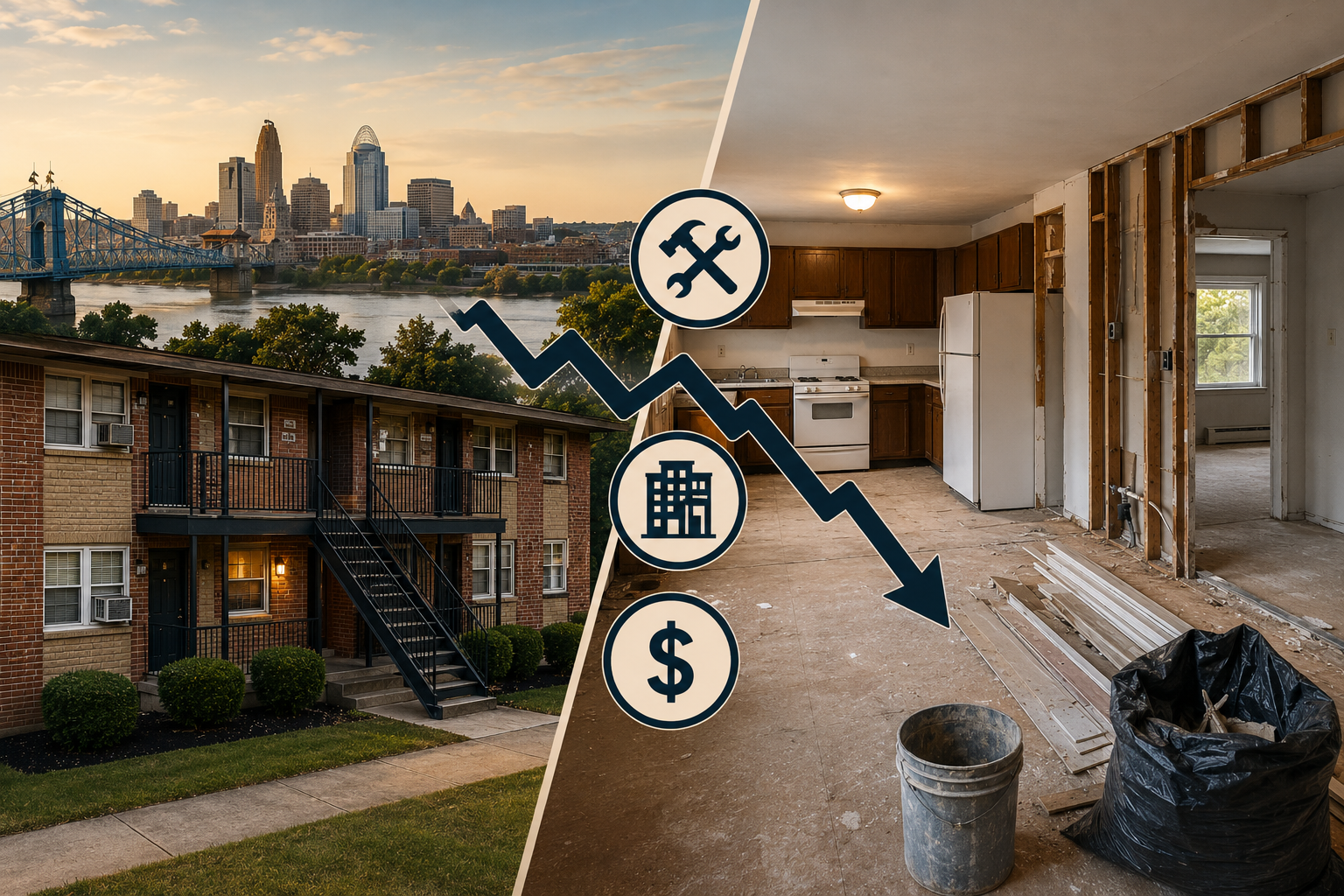
Halsey bought three auctioned fourplexes on Elberon Avenue in Price Hill in July 2024, his first purchase on Cincinnati's West Side, financed with six-month hard money and a mad dash to stabilize 12 units, several of which were not paying rent at closing.
The complication arrived roughly eight months later, in March, when a non-paying tenant Halsey was in the process of evicting turned on the gas in one of the units, causing an explosion that leveled the entire building. Halsey learned the difference between actual cash value and replacement cost value insurance coverage in real time as the claim unfolded; fortunately, he had replacement cost value coverage in place.
- Verify replacement cost value coverage before an unplanned total loss forces you to find out the hard way. The distinction between actual cash value and replacement cost value determined whether this loss was financially survivable.
- A fast-moving disaster can outpace your insurance company's own inspection timeline. The building was demolished before the adjuster ever saw it standing, which could have complicated the claim under different circumstances.
- Entering a new submarket for the first time carries compounding risk. Halsey had zero prior ownership experience on the West Side when he bought these properties, layering unfamiliar-market risk on top of the non-paying tenants he inherited at closing.
- A property in active eviction still carries real risk until the tenant is physically out. The non-paying tenant responsible for the explosion was already in the eviction process at the time of the incident.
- Undervalued, highly leveraged acquisitions can absorb unplanned setbacks better than fully-priced deals. Because Halsey had captured meaningful equity at acquisition, the property's destruction did not represent the same financial exposure it would have on a deal bought at full market value with thin margins.