

Hunter, Hammer, Brain, Money: A Framework for Real Estate Partnerships

How Ian Cruz and Slocomb Reed used four defined roles to scale from an 8-unit Northside deal to 73 units in under two years — plus what Cincinnati's rental data shows right now.

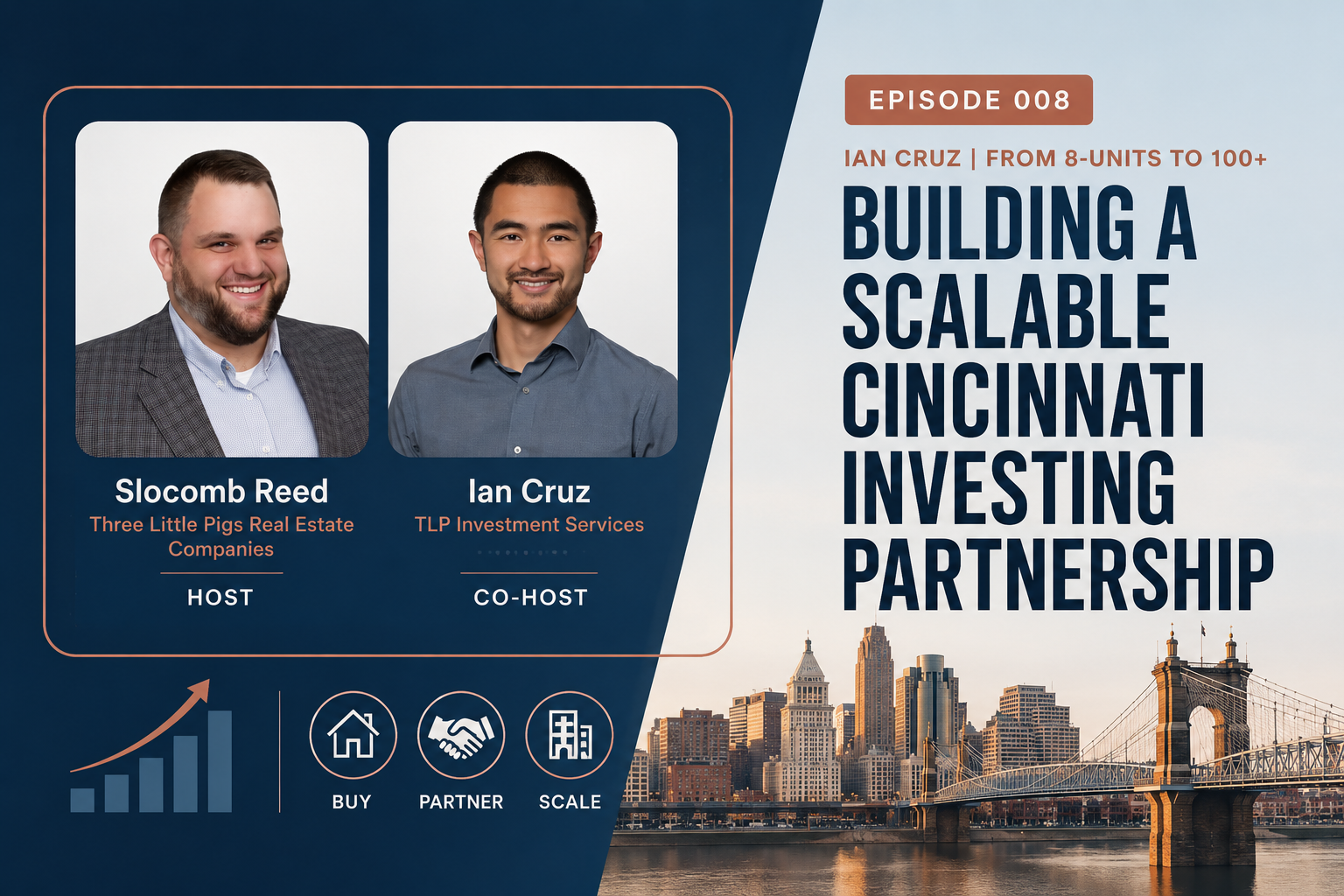
Greater Cincinnati had 1,264 active rental listings against 1,730 active for-sale listings as of late February 2026, according to a proprietary web scrape TLP Investment Services had just launched. Ian Cruz and Slocomb Reed, co-founders of TLP Investment Services, shared that data alongside a breakdown of how their own partnership scaled from an 8-unit value-add deal to a 73-unit portfolio in under two years, at a live session of Cincinnati's Best Ever REI Mastermind.

About This Post

This analysis draws from a live presentation by Ian Cruz and Slocomb Reed, co-founders of TLP Investment Services, at Cincinnati's Best Ever REI Mastermind, a monthly meetup held at the Deer Park Community Center. Their combined finance and operations background, and the deals they walked through in real time, give this session an unusually direct look at how multifamily partnerships and financing actually come together.

Listen to the full conversation on Spotify, Apple Podcasts, and YouTube. The full episode also covers audience Q&A on partnership decision-making when partners reach an impasse, and more detail on how TLP structures general partner compensation.

The Cincy REI Show publishes every Monday. New episodes cover neighborhood-level analysis, local investor strategies, and real deal stories from operators active in Greater Cincinnati.

Where TLP Is Scaling Value-Add Multifamily in Greater Cincinnati

  • Northside is where TLP's partnership began, with an 8-unit deal in 2024: two four-family buildings sitting side by side, separately parceled, but listed by a commercial broker as a single 8-unit commercial property. The value play was recognizing that the combined residential valuation of the two buildings individually was meaningfully lower than what the commercial listing price implied. TLP exited that deal after about 18 months.
  • Northside and College Hill together make up TLP's 2025 portfolio, a 73-unit deal spanning six apartment buildings, five of them on the same Northside street and the sixth in College Hill. The properties are 1960s and 1970s C-class assets, occupancy has run below target due to some tenant turnover, but revenue is at the highest point since acquisition due to executed business plan improvements.
  • TLP is now under contract on a scatter-site portfolio of over 100 units, with plans to acquire a deal of similar size or larger every year going forward, using the acquisition and asset management capacity built across the first two deals.

What Cincinnati's Rental and For-Sale Data Actually Shows Right Now

TLP's web scrape, tracking specific Greater Cincinnati zip codes, surfaced several data points as of late February 2026.

  • Average days on market ran 57.8 for rental listings overall, with apartments at 59.2 and single-family rentals at 54, a smaller gap between the two than expected. For-sale listings averaged 85.8 days on market, roughly four weeks longer than rentals.
  • Price reductions hit over 300 of 1,734 active for-sale listings in just the four days before the meetup.
  • Rent figures across all rental listings averaged $1,718 a month with a median of $1,495. Apartments alone averaged $1,516 with a median of $1,300. Single-family rentals averaged $2,279 with a median of $2,095.
  • August 2024 marked a clear inflection point. Rents could be asked at nearly any level through that July, then by September the market flipped hard toward tenants, with price reductions and longer vacancies becoming standard.
  • A K-shaped split has held since that fall 2024 to winter 2025 transition. Premium locations and premium properties, class A assets, continue seeing rent increases and falling days on market. Older 1960s and 1970s one- and two-bedroom stock has stayed flat to declining over the same period.
  • Net move-ins at TLP's own portfolio ran nine more move-ins than move-outs over the trailing 12 months, one internal metric the team tracks alongside the market-wide data.

The structural point underneath all of it: Cincinnati real estate still has starter-home neighborhoods where purchase prices sit in the high $100,000s to low-to-mid $200,000s, a price range where owning still beats renting on a monthly cost basis, something increasingly rare in other major metros.

What's Working in Cincinnati

Partnership structure. TLP frames every partnership around four roles, useful for any investor considering bringing on a partner.

  1. The Hunter finds the deal. This person is wired to enjoy sourcing opportunities and stays plugged into brokers and off-market channels.
  2. The Hammer executes the business plan. This covers leasing, maintenance, and keeping CapEx under control once the deal closes.
  3. The Brain underwrites the deal. This role lives in the spreadsheets, structures the debt and equity, and builds the model the rest of the team executes against.
  4. The Money raises capital from investors and brings a base of relationships willing to fund the deal.

No single person fills all four roles well, and TLP's partnership works because Ian and Slocomb overlap enough to cover for each other while still each carrying primary ownership of distinct roles.

Financing structure by deal size. TLP's 8-unit deal used a local bank construction loan, sized specifically for CapEx items like clay sewer line replacement and tuck-pointing. The 73-unit deal used a Fannie Mae small balance agency loan instead, which carries a 30-year amortization and non-recourse terms compared to a 25-year amortization typical of local bank debt. The tradeoff is a far more rigorous underwriting process, particularly the property condition assessment required for older C-class assets.


Leasing tactics in a renter's market. TLP's primary tool is a three-month promotional rent, reducing the rent by roughly a third for the first three months of a lease. If that discount fills the unit even one month faster, the reduced revenue is offset by eliminated vacancy loss. TLP also shifted its leasing platform to one offering an AI-driven speed-to-lead response, which increased inbound inquiries by 50% and moved lead conversion from roughly 10% to 15% up to 53% in a single week.


What is not working: assuming a small property, like a single duplex or fourplex, can absorb unexpected vacancy or CapEx the way a larger portfolio can. TLP specifically markets to non-local investors who bought one small property in Greater Cincinnati and found the returns underwhelming, positioning passive investment in a larger portfolio as a better fit for that capital.


Lessons From the Field: Financing a $3 Million Bridge Loan in Five Days

TLP's 73-unit deal was already under contract and moving through Fannie Mae's small balance loan process when the property condition assessment required for agency debt came back demanding significant repairs before the loan could close. The seller was unwilling to make those repairs, and TLP did not want to spend money improving a property the seller still legally owned, with the risk the seller could simply take the earnest money and TLP's improvements and sell to someone else.


The seller issued an ultimatum on the night of the March mastermind meetup: close by the end of March or the deal would be pulled. That gave the team five days to arrange $3 million in short-term financing while the agency loan continued processing in the background.


The decision was to build a list of every hard money contact who might be able to fund that amount on short notice. The team fielded three separate loan offers, including one connection facilitated through Grant Smith at Sharper Capital Partners. They chose a different lender instead, one with no origination fee, reasoning that a slightly higher interest rate mattered less than an origination fee when the loan would only be outstanding for a few months.


The outcome was a closed deal on time, but with an added cost: the excess interest paid on the bridge loan compared to what the agency loan would have cost was absorbed entirely out of TLP's own acquisition fee rather than passed on to investors in the deal.

  1. A financing gap in the final days of closing is a real scenario, not a hypothetical. Property condition assessments on agency debt can surface repair demands late enough to threaten the entire closing timeline.
  2. A pre-built network of hard money contacts is the difference between losing a deal and closing it. TLP fielded three offers inside five days because those relationships already existed.
  3. No origination fee can matter more than a lower rate on genuinely short-term debt. The math changes when a loan is only outstanding for a few months rather than years.
  4. Absorbing unexpected cost into the acquisition fee, rather than passing it to investors, is a deliberate choice about who a partnership protects first. TLP treated protecting investor returns as non-negotiable even when it meant a smaller payout for the general partners.
  5. A defined exit strategy on a partnership matters as much as the deal itself. Every property in TLP's portfolio has a set sale deadline, which the team credits with keeping decision-making focused even when individual deals get stressful.
September 4, 2026
The Hamilton County timeline from a missed rent payment to a set-out; and why TLP's Izzy Ong treats every case that reaches a magistrate as a failure of the process, not a win.
September 3, 2026
A $450,000 Loveland listing sold for $570,000 cash. Ethan Bishop on which Greater Cincinnati submarkets are drawing multiple offers, which have quietly cooled, and the two-generation demand pattern driving both.
September 2, 2026
Off-street parking, galvanized plumbing, school district lines that don't follow township borders, and a tax bill that can quadruple at closing. The Cincinnati-specific due diligence most investors skip.
August 31, 2026
JD Schmerge brokers Greater Cincinnati multifamily and operates a 7-unit in South Covington. Why tenants aren't paying for upgraded finishes, why insurance and taxes now outweigh interest rates, and how much to renovate before selling.
August 28, 2026
Bret Halsey went from pro soccer to 70-plus units in under three years, 14 of them fourplexes. How Cincinnati's repeating 1960s floor plans make the city's most common multifamily building the easiest one to underwrite.
August 27, 2026
Nine of 24 units were paying rent. Slocomb Reed took over management three months before closing, cleared the building, and proved higher rents; all before owning a share of it.
August 27, 2026
Reading, Ohio: Cincinnati's Unlikely Development Hotspot
August 26, 2026
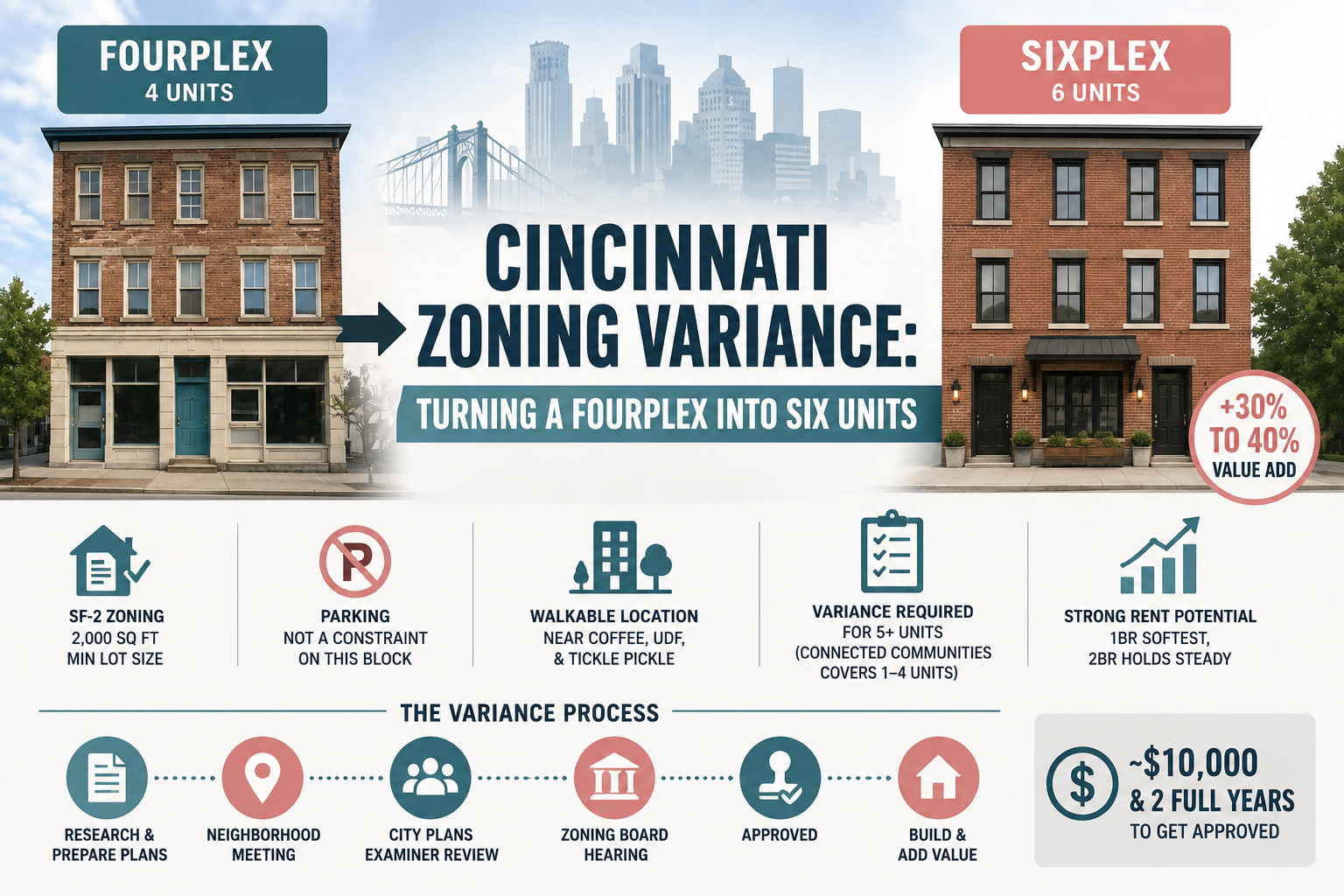
Two years, roughly $10,000 in zoning costs, and about 40 neighbor signatures. What Jeremy Komer's Northside conversion reveals about Cincinnati's variance process and the gap in Connected Communities.
August 25, 2026
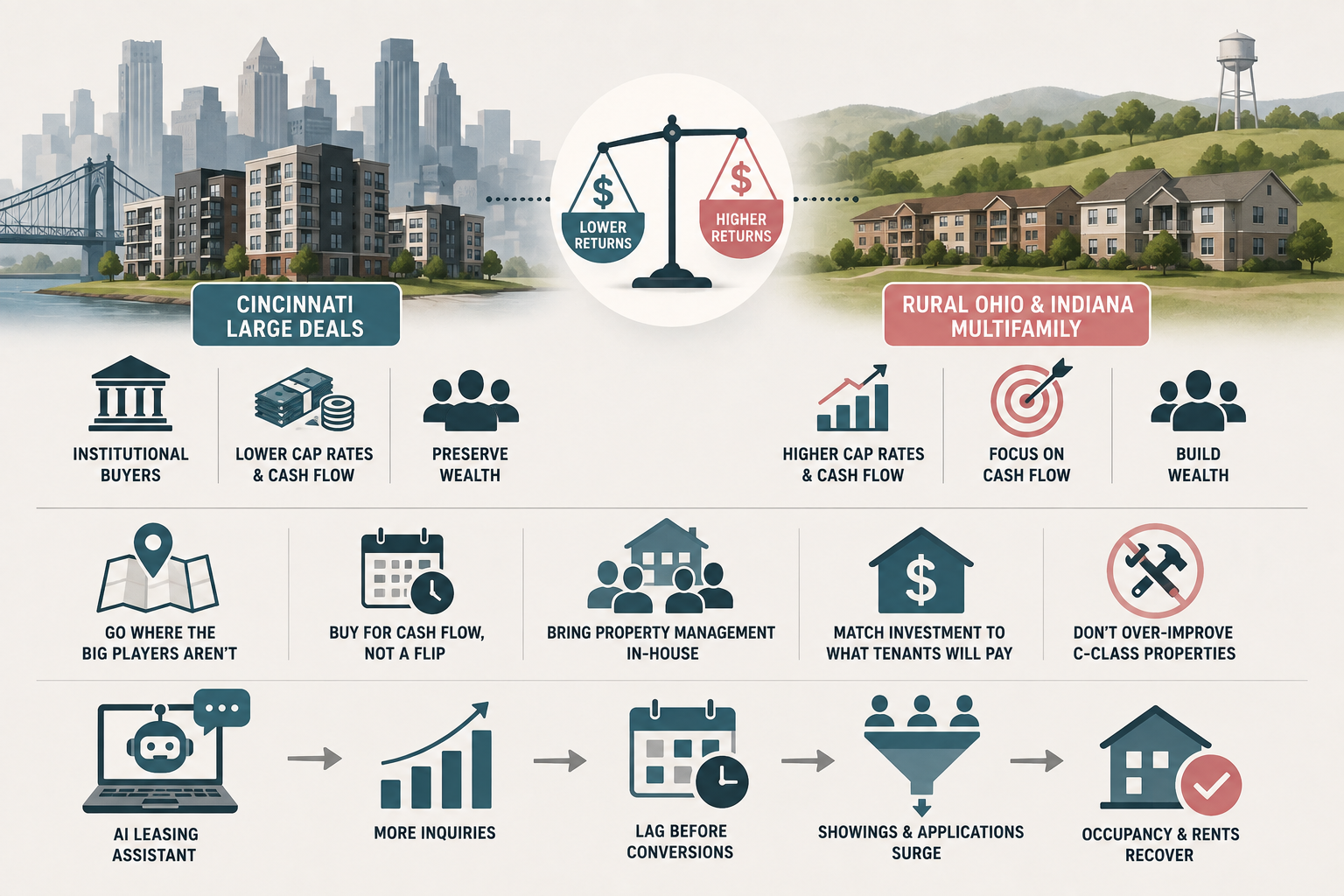
Lee Yoder holds 930 units, and almost none of them are near Cincinnati. Why institutional capital compresses returns above 100 units, and what he found in rural Ohio and Indiana instead.
August 20, 2026
Hedge funds are gone, rates broke the buy-and-hold math, and Cincinnati's off-market deal flow now turns block by block. Where the deals are and what buyers inherit when they sign.