Reading, Ohio: Cincinnati's Unlikely Development Hotspot
Commercial rents on Benson Street in
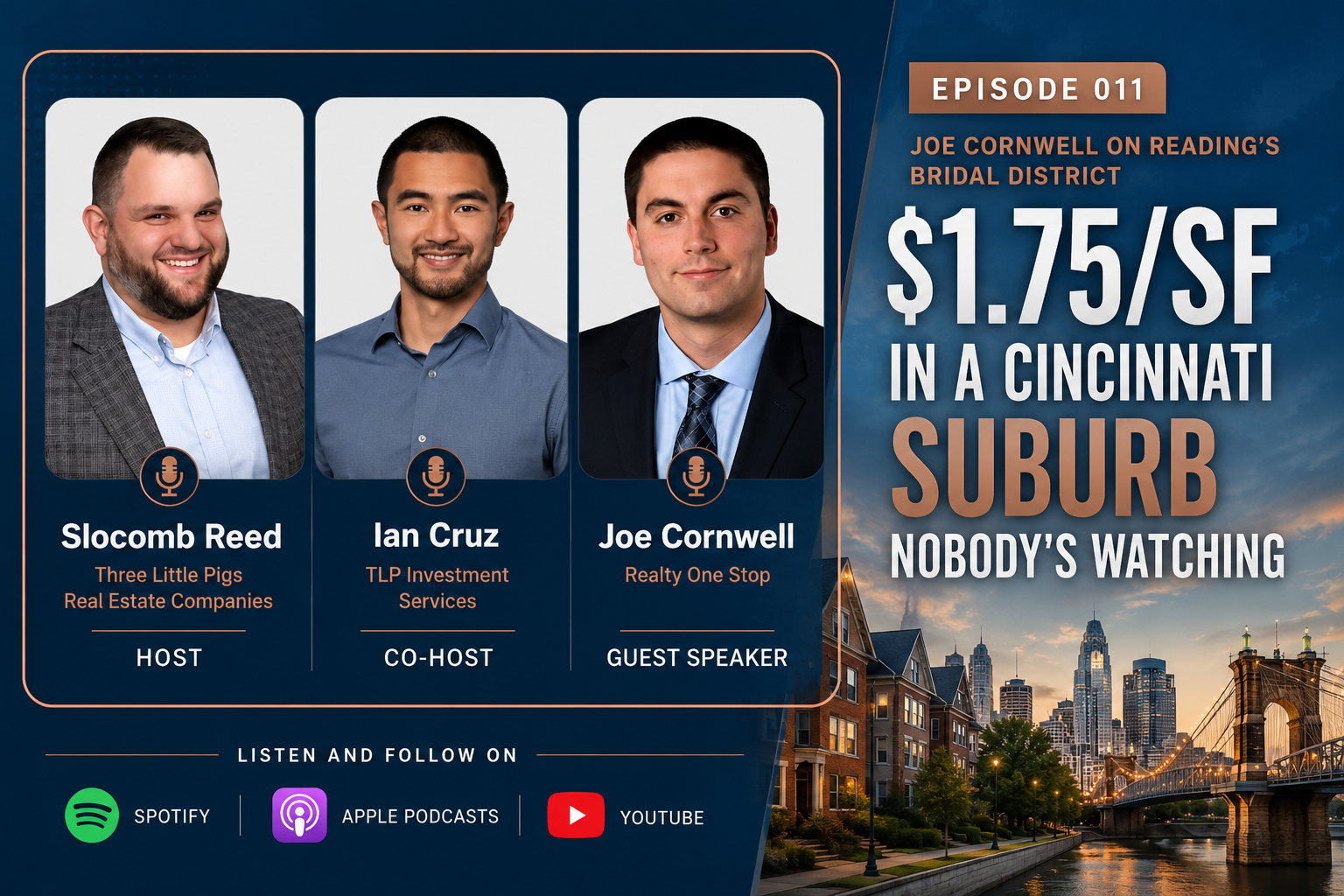
Reading, Ohio, a four-block corridor known as the largest bridal district in the world per capita, now rival what landlords command on Main Street downtown or at The Banks, Cincinnati's most prime real estate. Joe Cornwell, founder of Realty One Stop and a vertically integrated developer with over 140 units under management, is in the middle of converting a 1905 theater there into a 75,000-square-foot mixed-use building with 44 apartments, a project that illustrates just how much value sits in Cincinnati's under-the-radar corridors once someone is willing to do the ground-up work.
About This Post
This analysis draws from a conversation with
Joe Cornwell, founder of Realty One Stop and ROS Construction, a vertically integrated Cincinnati developer whose portfolio includes over 140 multifamily and mixed-use units, with assets under management projected to reach $20 million to $25 million once his current Reading development stabilizes. Cornwell's construction background and hands-on role in Reading's redevelopment give him unusually specific, ground-level detail on a niche corridor most Cincinnati investors have never analyzed.
Listen to the full conversation on
Spotify,
Apple Podcasts, and
YouTube. The full episode also covers Cornwell's advice on which older Cincinnati housing stock is worth a bathroom addition versus a full second-story pop-top, and more detail on Reading's new tax abatement program.
The Cincy REI Show publishes every Monday. New episodes cover neighborhood-level analysis, local investor strategies, and real deal stories from operators active in Greater Cincinnati.
The Bridal District: Why Four Blocks Command Downtown Rents
Reading's Bridal District runs along Benson Street for about four blocks west of Reading Road, bordering the neighboring community of Lockland. It holds more unique bridal retailers and designer lines than anywhere else in the world, drawing clients from New York, Texas, California, Florida, Canada, and internationally. That retail draw translates directly into commercial rent, priced comparably to downtown Cincinnati's core business district, but the premium drops off sharply outside the immediate corridor. Rents fall dramatically just one block north or south of Benson Street, since foot traffic concentrates almost entirely on that single streetscape.
Why Infill Development Inside 275 Is So Rare in Cincinnati
Ground-up development inside the I-275 loop faces a structural barrier that outer suburbs do not: there is almost no available land. Roughly 99% of the core Hamilton County and western Clermont County footprint is already built out, which pushes most new residential construction toward the region's outer edges, where land is cheap and jurisdictions actively incentivize farmland development.
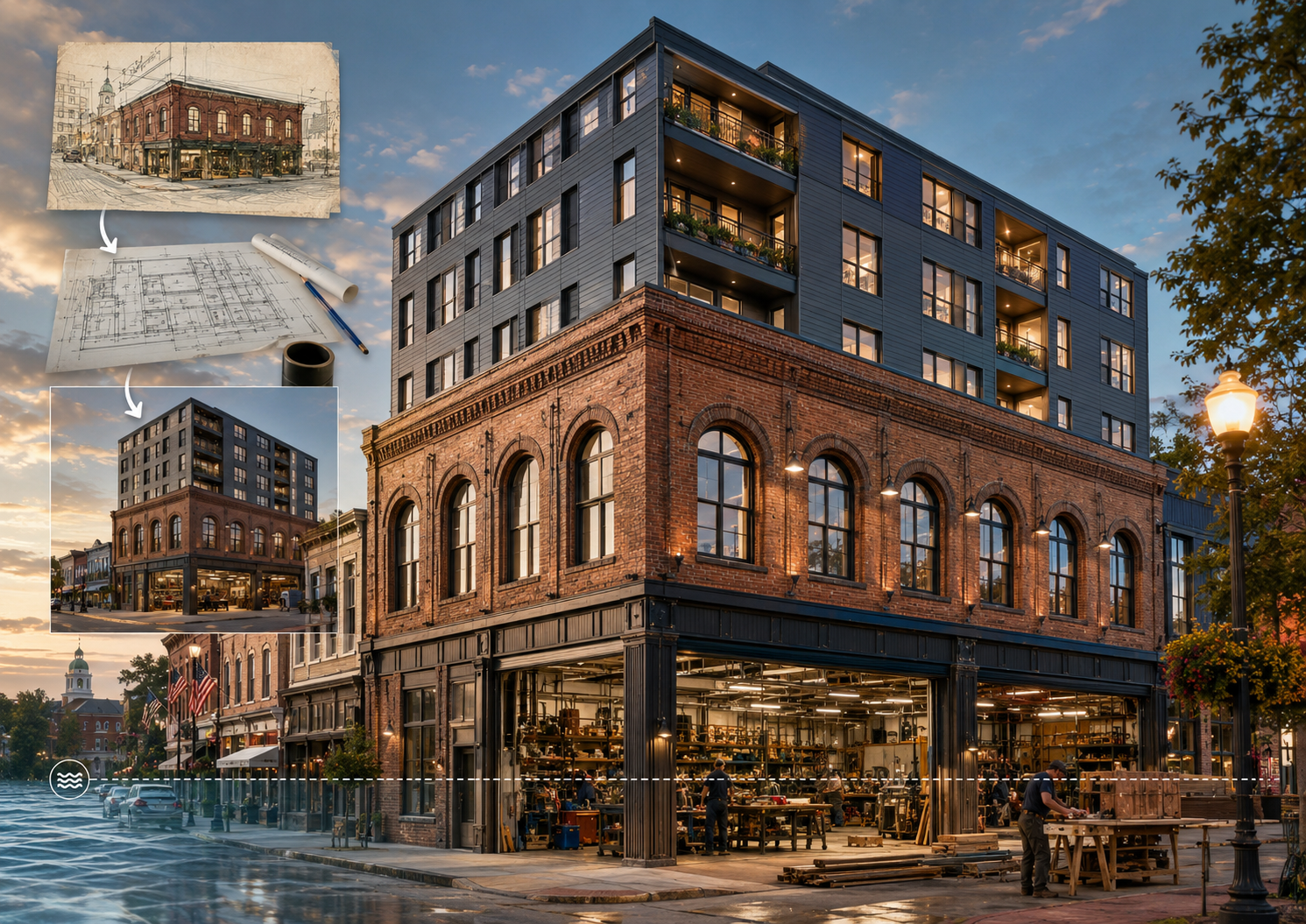
Building inside the loop typically means either tearing down existing structures or, as Cornwell's project does, a hybrid approach that preserves part of an existing building while adding new construction around it. His team kept the original 1905 theater's exterior brick walls and roofline while completely gutting the interior down to the dirt, then assembled three additional parcels, a house, an empty lot, and an alleyway, to create roughly 100 parking spaces alongside the development.
This scarcity is exactly why Reading's local government stands out. The city is actively incentivizing developers and investors through code enforcement on neglected properties and a newly passed Community Reinvestment Area tax abatement covering the entire valley, a level of municipal cooperation Cornwell says is rare for a small Hamilton County municipality. For an investor evaluating
Greater Cincinnati infill opportunities, that kind of local government alignment can matter as much as the underlying real estate fundamentals.
What's Working in Cincinnati
Cornwell's underwriting on the Reading development surfaced a clear unit-mix pattern that applies broadly to multifamily development in
Cincinnati real estate.
- Two-bedroom, two-bathroom units produce the best rent per square foot. Cornwell's underwriting lands at roughly $1.75 per square foot, projecting about $1,750 a month on a 1,000-square-foot two-two. Larger three-bedroom units and smaller one-bedroom units both see rent per square foot decline, since adding a bedroom or bathroom to an already self-contained apartment costs relatively little compared to the fixed cost of kitchen, appliances, and HVAC already built into the unit.
- The second full bathroom is what young professional tenants are actually paying for. Cornwell's target tenant, single or partnered, often hybrid-working, wants a private en-suite bathroom off the primary bedroom plus a separate bathroom for guests or a roommate, a distinction that matters more to this tenant class than raw square footage.
- Older Cincinnati housing stock rewards different renovation strategies depending on era and neighborhood. Cape Cod-style homes, common across
Deer Park, Norwood, Reading, and similar central-to-east side suburbs built in the 1940s through 1960s, typically have a plumbing stack already running near the upstairs landing closet, making a second bathroom addition there relatively cheap. Turn-of-the-century American Foursquare homes in neighborhoods like
Oakley, Hyde Park, Price Hill, Westwood, Evanston, Avondale, and
North Avondale were built without a shared guest bathroom at all, since the era's norm was that guests never used a resident's private bathroom. Adding a half bath off the living area or kitchen in these homes, often by reclaiming space from an underused formal dining room, is now one of the highest-return renovation moves available in that housing stock.
- A two-to-three-times return threshold governs whether a renovation makes sense. Cornwell's rule of thumb: if a $100,000 renovation on a $100,000 purchase does not add at least $100,000 in equity, and ideally closer to $200,000, it is not worth doing.
What is not working: assuming ground-up development delivers fast returns. Cornwell is direct that development is neither easy nor quick money, and that a comparable amount of capital and time could produce faster, more certain returns through value-add acquisitions instead.
Lessons From the Field: What a Floodplain Discovery Did to a 44-Unit Development
knew about going in. What they did not fully anticipate was how complex FEMA-compliant building code would turn out to be once engineering work began on the roughly 11,000-square-foot ground floor footprint of the old theater building.
The complication was structural: any space below the required flood elevation could not be used as occupied residential or commercial space at all. That ruled out the ground floor's originally planned mix of retail, office, and residential use entirely, since the entire footprint sat below the mandated elevation.
- A known floodplain designation does not mean you understand its full building code implications. The general flood risk was known upfront. The specific FEMA compliance requirements only surfaced once detailed engineering began.
- A forced design change can improve the deal instead of derailing it. Losing ground-floor residential and commercial space led directly to an additional apartment floor, growing the unit count from 38 to 44.
- Vertical integration turns an underwriting problem into a business opportunity. Rather than treating the oversized shop space as wasted square footage, the team is treating it as inventory to actively monetize through their own construction company.
- Development-stage uncertainty can run far longer than most investors expect. Twelve months passed between going under contract and having certainty the deal would actually close, a timeline Cornwell says makes ground-up development unsuitable for anyone seeking fast or passive returns.
- Outside feedback questioning a deal's difficulty is worth hearing, but does not have to change the decision. Experienced mentors who underwrote the deal told Cornwell the numbers worked, but questioned why he would choose a harder path than easier, faster real estate strategies available at similar scale. Cornwell and his partner proceeded anyway, treating the project's difficulty as part of its appeal rather than a reason to avoid it.