JD Schmerge brokers Greater Cincinnati multifamily and operates a 7-unit in South Covington. Why tenants aren't paying for upgraded finishes, why insurance and taxes now outweigh interest rates, and how much to renovate before selling.
Cincinnati multifamily has historically traded at 7% to 8% cap rates, a spread wide enough above today's roughly 6.5% debt cost that the market never saw the same distress hitting cities that traded at 4% and 5% caps during the low-rate years. JD Schmerge, a multifamily broker with Sabre Group who also owns a 7-unit property in South Covington, has a front-row view of both sides of that math right now, as a broker underwriting deals and as an operator absorbing insurance and tax increases firsthand.
About This Post
This analysis draws from a conversation with
JD Schmerge, a multifamily broker at Sabre Group with over eight years of experience, primarily selling properties under 75 units across Greater Cincinnati. Schmerge's dual perspective, brokering deals across the market while personally operating a 7-unit value-add property in South Covington, gives this episode a level of real-time detail on financing, insurance, and taxes that pure sales data alone would not surface.
Listen to the full conversation on
Spotify,
Apple Podcasts, and
YouTube. The full episode also covers Schmerge's take on Ohio's proposed property tax legislation and more detail on how school district board of revision cases work.
The Cincy REI Show publishes every Monday. New episodes cover neighborhood-level analysis, local investor strategies, and real deal stories from operators active in Greater Cincinnati.
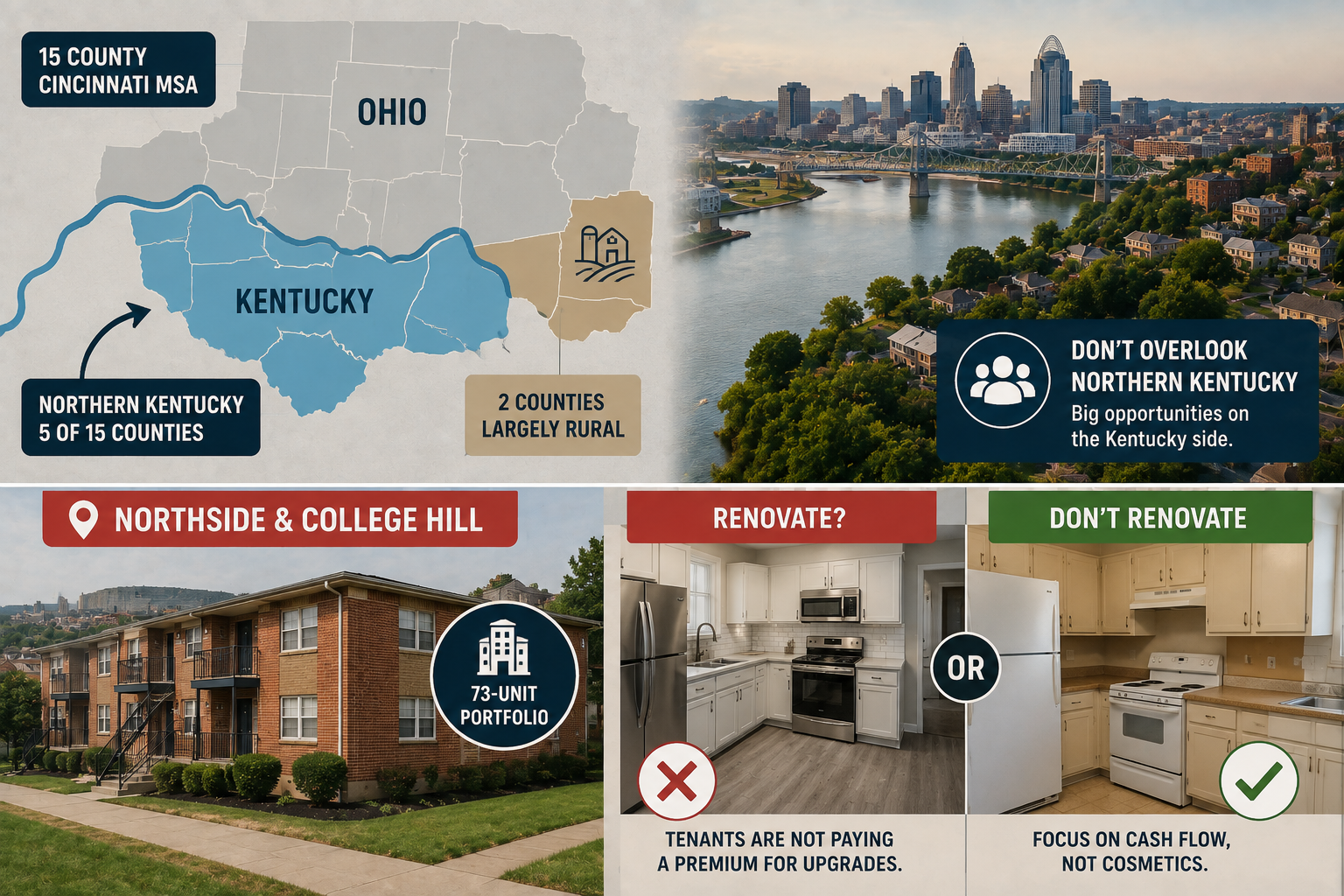
Cincinnati Multifamily Geography: South Covington and the Northern Kentucky Case
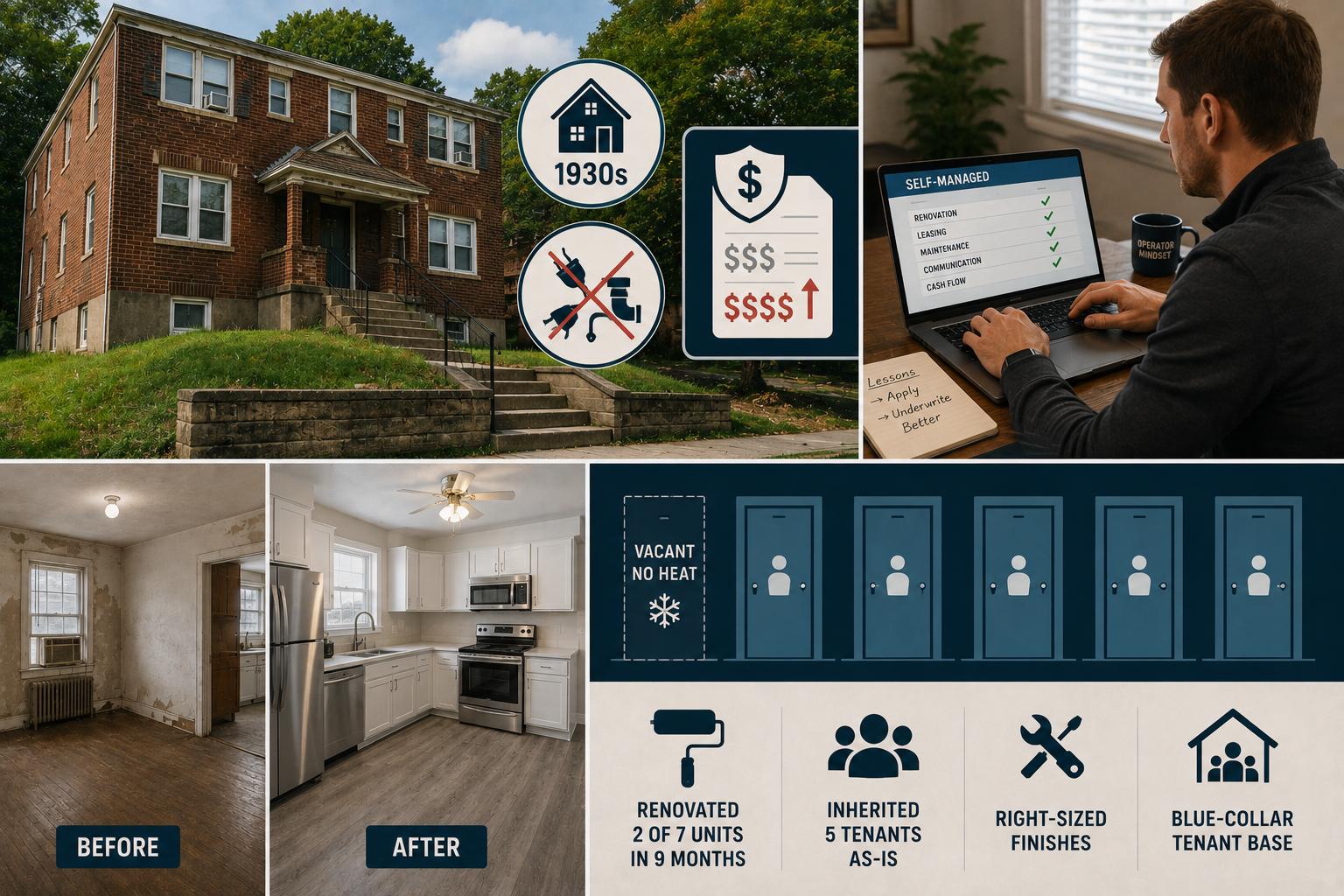
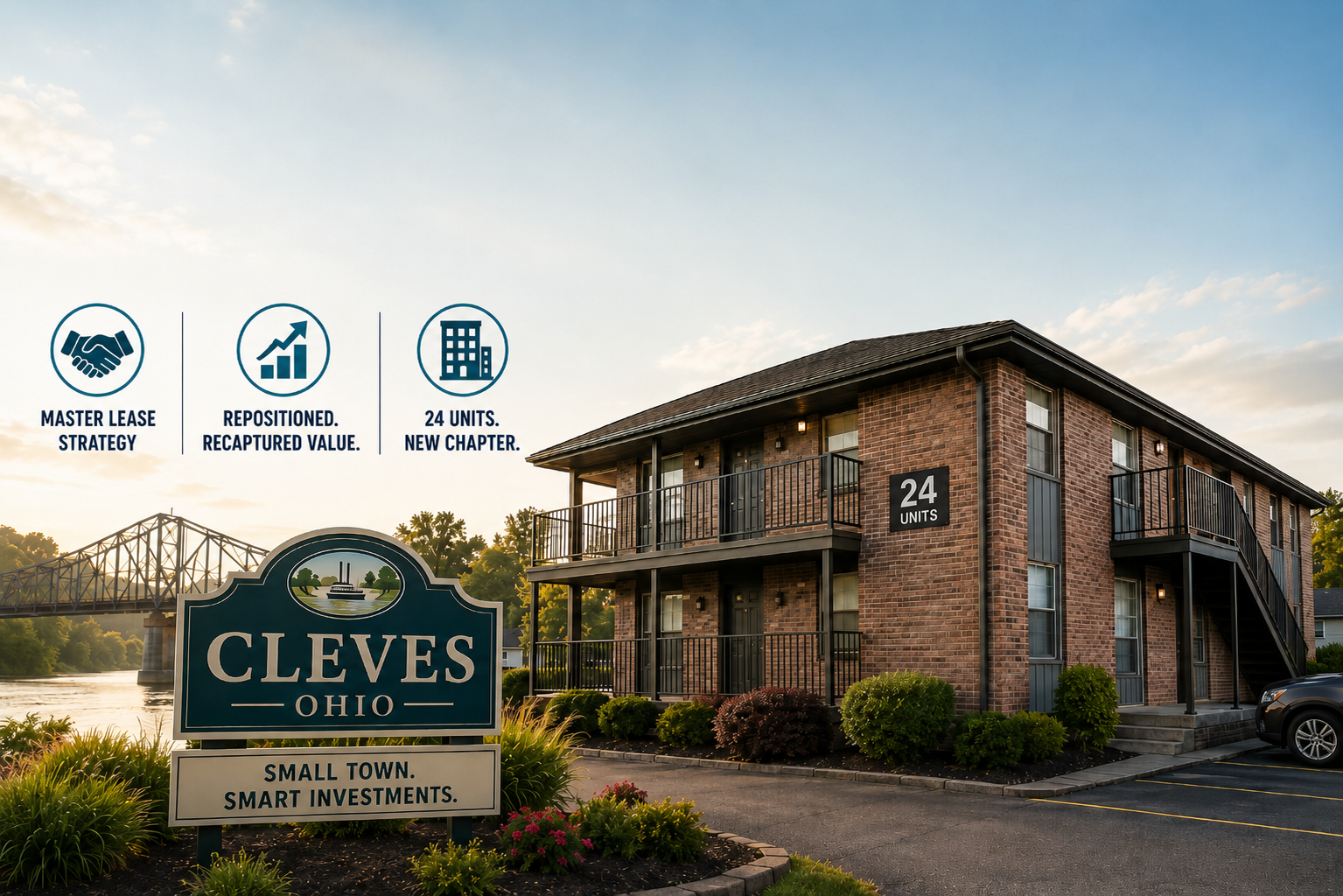
South Covington, roughly two miles south of the Ohio River and just before the Wallace Woods neighborhood, is where Schmerge owns a 7-unit value-add property purchased in September 2025. He describes the building as a C-minus or D-class asset at acquisition, in a blue-collar neighborhood where he is deliberately avoiding over-improving finishes, with a goal of reaching B-minus or B-class within two years.
Why Cincinnati Multifamily Avoided the Distress Other Markets Saw
Three structural factors explain why 2025 was one of Cincinnati's lowest multifamily transaction volume years without producing the kind of forced, distressed sales seen in other metros.
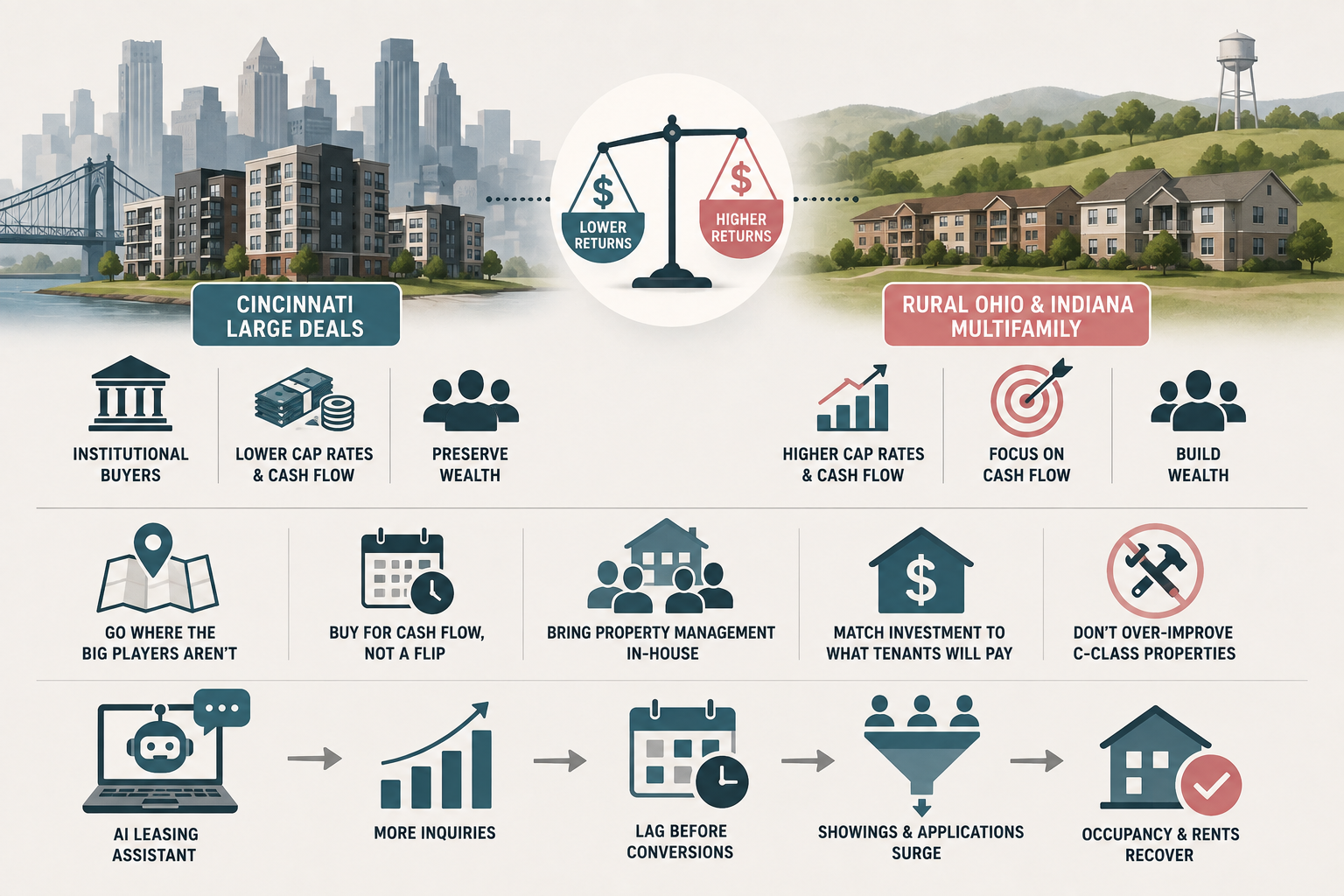
Cincinnati's traditionally wide cap rate spread over debt cost is the biggest factor. Markets that traded at 4% to 5% cap rates during low interest rate years now face debt costs that exceed their in-place returns, forcing refinances that do not pencil. Cincinnati's historical 7% to 8% cap rate range, even with debt costs around 6.5%, still preserves a workable spread, meaning deals bought at the top of the last cycle are still refinancing at debt service coverage ratios that generally work.
Limited new construction keeps supply pressure lower than in faster-growing metros. Cincinnati typically has only 2% to 3% of existing multifamily inventory under construction at any given time, compared to double-digit percentages in some primary markets betting heavily on continued population growth.
Insurance and property tax increases have become the two biggest underwriting variables, overshadowing interest rates in some cases. Schmerge's own South Covington property carries an insurance premium more than double what the previous owner paid, a gap he attributes to the building's 1930s construction and outdated mechanicals rather than any error on the prior owner's part. Insurance underwriting for older Cincinnati-area multifamily now runs roughly $600 per unit as a rough baseline, though square footage, age, and mechanical updates all shift that figure meaningfully.
Property tax reassessment mechanics differ sharply between Ohio and Kentucky. On the Kentucky side, a sale typically triggers reassessment to the purchase price within the first 12 months of ownership, with subsequent reassessments roughly every three years, and increases have generally stayed modest. On the Ohio side, Hamilton County's 2023 triennial reassessment averaged a 65% increase from 2020 values, a shock that has made property tax forecasting a much bigger underwriting conversation for
Cincinnati real estate than it has historically been. A proposed Ohio bill addressing property taxes for owner-occupants is being watched closely, since any reduction in that tax base will likely need to be recovered elsewhere, a risk school districts and counties are already responding to with more aggressive board of revision activity against recently sold properties, particularly around Ohio's drop-and-swap strategy, which Schmerge notes is already facing more scrutiny in Columbus and Cleveland than it currently does in Cincinnati.
What's Working in Cincinnati
Schmerge's brokerage experience surfaces a specific, quantifiable framework for how much renovation work a seller should actually complete before bringing a value-add multifamily deal to market.
- Leave meaningful upside for the next buyer rather than fully stabilizing a property. Schmerge's rule of thumb: renovating as few as 10% of units at top-of-market rents can establish proof of concept, though that threshold is more reliable on larger properties, a 30-to-50-unit building rather than a small one where a single renovated unit is not a real sample size. Renovating beyond roughly 70% of units starts producing diminishing returns for the seller, since it shrinks the pool of buyers looking specifically for a value-add opportunity.
- Selling unrealized upside commands a lower cap rate than selling in-place cash flow. Schmerge is direct that brokers can sell a buyer pool on future NOI growth potential far more easily than they can sell current in-place performance, since in-place NOI is fixed while unrealized upside lets a buyer's imagination, and their eventual lender, justify a stronger valuation.
- Consider turnkey acquisitions specifically because most buyers avoid them. Schmerge estimates roughly 98% of buyers are chasing value-add deals, which has made genuinely turnkey, cash-flowing properties comparatively overlooked and less competitive to acquire, provided a buyer verifies the turnkey claim is real rather than cosmetic.
- Underwrite insurance and tax increases explicitly rather than assuming the seller's current expenses will hold. Schmerge's own experience paying more than double the previous owner's insurance premium illustrates how easily an underinsured or outdated policy can distort a seller's reported operating expenses.
- Match renovation spend to what the current tenant base is actually willing to pay for. Echoing Ian and Slocomb's own 73-unit portfolio decision, Schmerge agrees that in the current market, upgrading finishes tenants are not paying a premium for is money that will not come back in rent growth, and that capital is better spent on safety and mechanical improvements that do not show up as prominently in marketing photos.
Lessons From the Field: What a First-Time Owner-Operator Learned From His Own Deal
Schmerge closed on his 7-unit South Covington property in September 2025, after years of brokering multifamily deals for other buyers without ever taking one down himself. He had been waiting for a turnkey, cash-flowing deal to simply present itself, but as the end of the year approached and he wanted to capture bonus depreciation, he decided a heavier value-add deal was the better move despite not being his original plan.
The outcome nine months in: full occupancy, though leasing the renovated units took more showings and slightly longer than expected, partly because the renovation and initial leasing period fell during December and January, typically the slowest leasing months of the year. Schmerge did not have to lower his advertised rent to fill the units despite the slower timeline.
- A turnkey deal may never simply appear, even for a broker who sees every listing in the market. Schmerge waited a meaningful amount of time expecting one to surface before deciding a value-add deal made more sense given his tax planning timeline.
- Verify the actual insurance policy in place rather than assuming the seller's premium reflects the building's true risk. A policy that looks affordable on paper may simply be underinsured, a gap that only becomes visible once a new buyer gets their own quotes.
- Self-managing a first value-add deal builds underwriting judgment that brokerage alone does not provide. Schmerge specifically credits hands-on renovation and leasing experience with sharpening his ability to evaluate line-item renovation costs for other clients' deals.
- Winter leasing timelines require real patience even when the fundamentals are sound. More showings and a longer fill time in December and January did not require a rent reduction, but did require adjusting expectations for how quickly newly renovated units would lease.
- A blue-collar tenant base sets a ceiling on how aggressive renovation should be. Schmerge's plan to reach B-minus or B-class within two years, rather than pursuing a full luxury reposition, reflects a deliberate match between renovation scope and what the local tenant base can support.