


Cincinnati Wholesaling in 2026: Why Buyers Are All Flippers Now

Hedge funds are gone, rates broke the buy-and-hold math, and Cincinnati's off-market deal flow now turns block by block. Where the deals are and what buyers inherit when they sign.

Dylan Koch has closed roughly 300 off-market transactions since starting Morning Brew Properties in late 2021, and the buyer pool on the other side of those deals has changed completely. He used to sell heavily to hedge funds and small multifamily buy-and-hold buyers. Now, over the past 12 to 18 months, he is selling almost exclusively to flippers, a shift driven by interest rates that make buy-and-hold math harder to pencil across much of Greater Cincinnati.

About This Post

This analysis draws from a conversation with Dylan Koch, founder of Morning Brew Properties, a direct-to-seller marketing and wholesaling company operating across Hamilton, Butler, Warren, and Clermont counties. Koch's data set spans roughly 300 off-market transactions and a 50-unit rental portfolio built entirely from his own deal sourcing, giving him an unusually current read on where deal flow is concentrated and how the buyer pool has shifted.

Listen to the full conversation on Spotify, Apple Podcasts, and YouTube. The full episode also covers Koch's transition from working as a pharmacist into full-time real estate investing, and a full breakdown of what wholesalers look for in a serious buyer.

The Cincy REI Show publishes every Monday. New episodes cover neighborhood-level analysis, local investor strategies, and real deal stories from operators active in Greater Cincinnati.

Where Cincinnati's Off-Market Deals Are Flowing in 2026

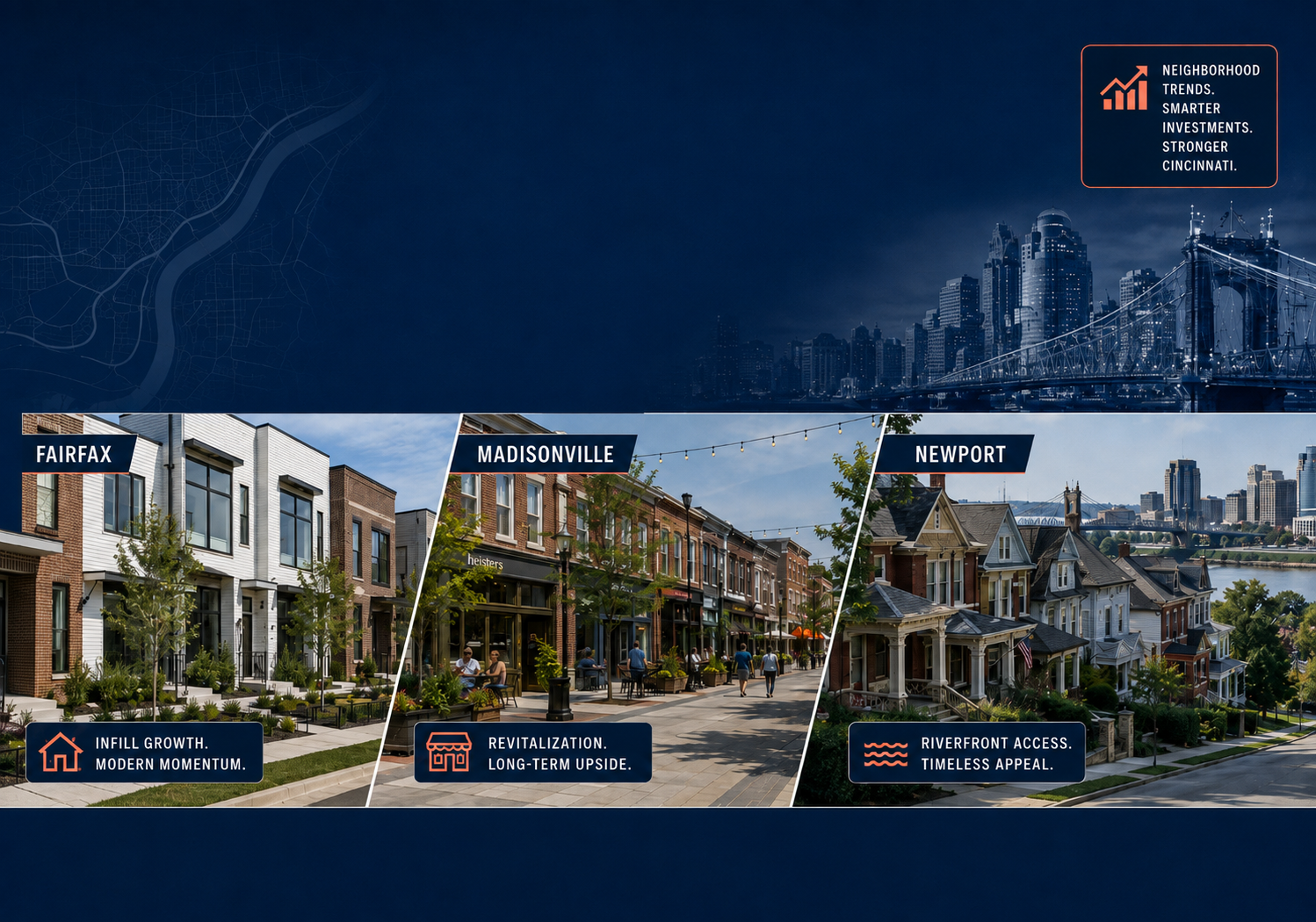
  • Hamilton, Ohio, in Butler County, has been the biggest surprise in Koch's five years of buying, largely concentrated in zip codes 45011, 45013, and 45015 on the west side of the river. Demand there is tied directly to the Spooky Nook Sportsplex and a wave of private development downtown.
  • Cheviot, Westwood, and Delhi, on Cincinnati's west side, are Koch's strongest rental markets, driven by a favorable price-to-income ratio. Properties zoned for Oak Hill schools sell especially well.
  • Deer Park, Pleasant Ridge, Evanston, and Avondale, on the east side, round out Koch's rental targeting. Avondale tends to carry a lower price point relative to its rental income potential.
  • Madisonville was a major focus for Koch in 2022, but by 2026 it has become difficult to comp. Similar homes matching on beds, baths, square footage, and proximity to MedPace and the Ackerman Group's new development can differ in value by hundreds of thousands of dollars depending on the specific block.
  • Norwood carries the same block-by-block unpredictability. Koch describes it as having distinct sub-markets within the same zip code, where comps a few streets apart do not translate.
  • Evanston, Avondale, and North Avondale together require close, block-level attention. Some blocks show serious upside potential, and adjacent blocks carry real red flags.
  • Reading behaves similarly to Norwood, split between its walkable Vital District and the surrounding hill-and-valley terrain, with sharp value lines between them.
  • St. Bernard holds Koch's largest personal rental portfolio. Comps there can run from $350,000 to $400,000 on one block and drop to $175,000 to $200,000 just a couple of blocks away. The small downtown has been building real walkability over roughly 15 years, evidenced by a new Dairy Queen that reportedly draws a line of 25 people.
  • Hyde Park and Oakley produce fewer deals for Koch. Higher price points mean sellers with real equity are less willing to take the discount a flipper's numbers require.

Koch's marketing footprint mirrors this pattern geographically: all of Hamilton County, the southern and northwest portions of Butler County up to about Franklin, the west side of Clermont County out to roughly Bethel, and limited activity in Warren County near Mason and Loveland.

Why Cincinnati Wholesale Deals Are Shifting from Rentals to Flips

Two structural shifts are reshaping who buys wholesale deals in Cincinnati real estate right now.


The first is the buyer pool itself. Hedge fund buyers, active and easy to sell to through roughly 2022 and 2023, largely exited the market by late 2023. Small multifamily buy-and-hold buyers, once a steady segment for two-to-four unit properties, have also thinned out as interest rates compressed rental math. Flippers are now close to Koch's entire buyer list.


The second is a change in who is selling. Koch is seeing more homeowners who bought in 2021 or 2022, often with 3.5% to 5% down, raise their hand to sell now. Despite several years of appreciation, many do not have the 30% to 40% equity a flipper needs to hit a 70% to 75% of ARV minus repairs target. Foreclosures remain a steady, gradually increasing lead source across Hamilton, Clermont, Butler, and Warren counties, a trend Koch attributes to broader economic pressure rather than any single cause.


Underneath both shifts sits the same fixed-supply thesis driving much of **Greater Cincinnati** right now: homes with an ARV under $250,000 cannot be built new at that price today. That inventory is capped, renovation costs on it stay lower because buyer expectations are lower, and demand for it keeps rising as supply stays fixed or shrinks.

What's Working in Cincinnati

Koch's operation runs on a few specific mechanics that separate a professional wholesale operation from an amateur one in 2026.

  1. Target the sub-$250,000 to $350,000 ARV range. Koch intentionally avoids higher price points, where buyers expect $60-per-square-foot quartz finishes rather than the $40-per-square-foot white shaker cabinets and granite that work in his target range, and where sellers with real equity are harder to move off asking price.
  2. Back into the offer rather than using a flat percentage rule. Instead of the common 70% to 75% of ARV minus repairs formula, Koch calculates backward from realtor commission, holding costs, and loan costs, then requires a larger spread as the price point rises to compensate for the added time, energy, and risk.
  3. Screen buyers on cash position, experience, and speed. Cash beats hard money, hard money beats conventional financing, and a buyer's ability to close in 30 days or less matters as much as their offer price. Koch increasingly relies on a repeat list of 15 to 20 known buyers rather than mass marketing every deal.
  4. Budget for real overhead. Koch runs $10,000 to $15,000 a month in ad spend, $120,000 to $180,000 a year, and advises anyone entering wholesaling to expect a minimum three-month runway and to be prepared to spend $10,000 to $15,000 before seeing a return.
  5. Comply with Ohio's new wholesale disclosure rule. Ohio SB 155 now requires wholesalers to disclose, before the purchase agreement is signed, if the property will be mass marketed, with penalties reaching three times the assignment fee plus attorney fees for noncompliance.

What is not working: relying on an assignment agreement alone to understand a wholesale deal, and mass-marketing every property to a broad buyer list instead of building relationships with buyers who have already closed and performed.

Lessons From the Field: What You Inherit When You Sign a Wholesale Assignment

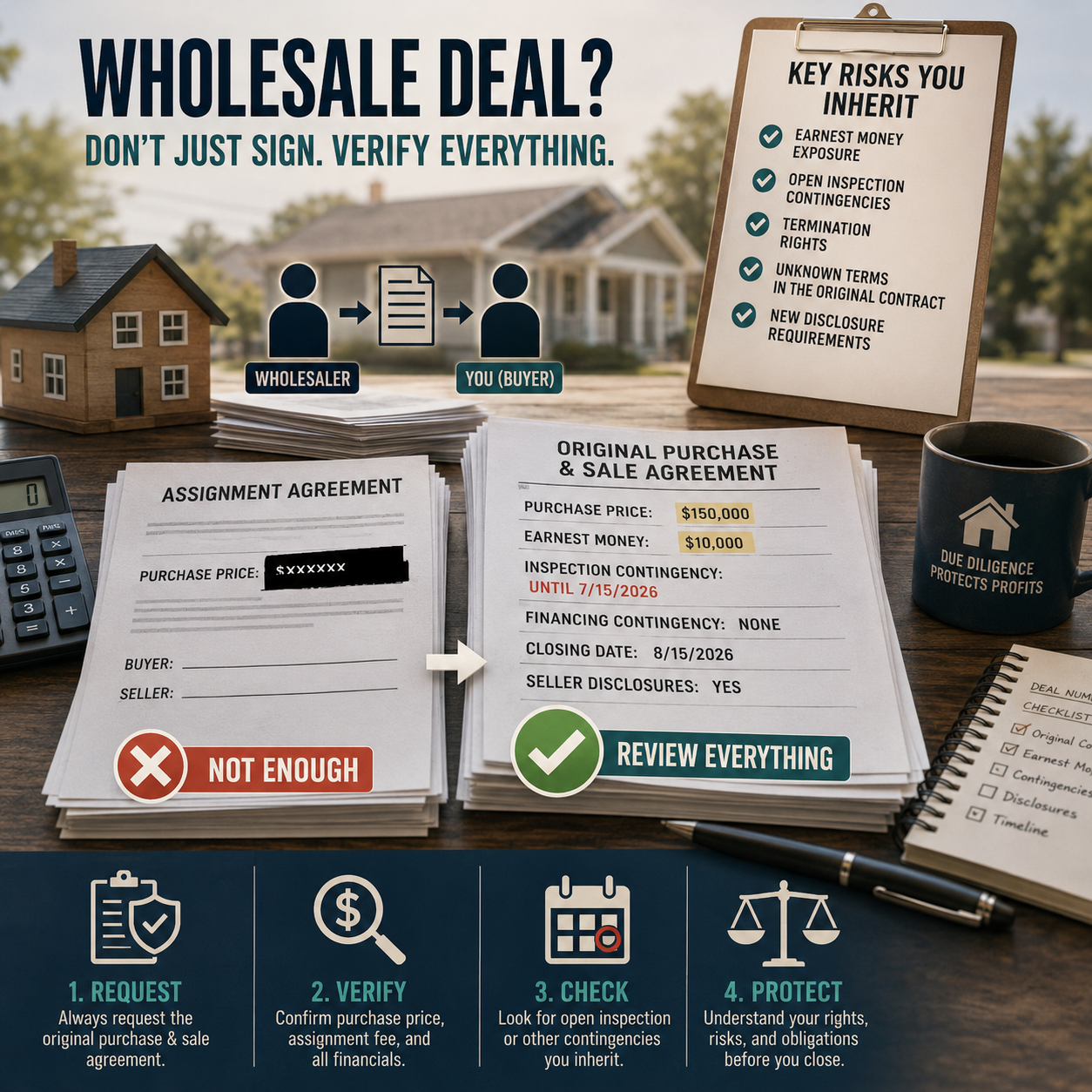
Ian recently went under contract on a deal from a wholesaler after Ohio's new disclosure rule took effect, which meant the wholesaler had to confirm in writing that the property would be mass marketed before the purchase agreement was signed. Because the wholesaler had not taken ownership of the property before assigning it, Ian requested the original purchase and sale agreement rather than relying on the assignment agreement alone.


The wholesaler initially tried to black out the purchase price. Ian required confirmation that the purchase price plus assignment fee still lined up with what he had agreed to pay, then reviewed the full original contract regardless. Two details surfaced that the assignment agreement alone would never have shown him: the size of the earnest money deposit he was now on the hook for if the deal fell through, and an inspection contingency the wholesaler had negotiated for themselves that was still open for another week and a half.

That inherited inspection contingency meant Ian could have terminated the contract unilaterally, without even involving the wholesaler, simply by delivering written notice to the seller. He had no intention of exploiting that position to kill the deal, but the discovery underscored a real gap in how assignment agreements work: they are built only to substitute the buyer's name onto the original contract, not to summarize or guarantee the terms underneath it.

  1. Always request the original purchase and sale agreement before signing an assignment. The assignment agreement itself is not designed to disclose earnest money exposure or contingency terms.
  2. Earnest money risk transfers to the assignee. If the deal falls apart after assignment, the new buyer, not the wholesaler, is typically the one who forfeits the deposit.
  3. Inherited contingencies are real leverage. A generous inspection period negotiated by the wholesaler becomes the buyer's leverage once the assignment closes.
  4. A blacked-out purchase price is a signal to verify, not skip. Confirming the underlying price against the total the buyer is paying is a basic check before proceeding.
  5. New disclosure law changes the paper trail on every wholesale deal. Both wholesalers and buyers now have a documented reason to request and retain the underlying disclosure and purchase agreement.
September 4, 2026
The Hamilton County timeline from a missed rent payment to a set-out; and why TLP's Izzy Ong treats every case that reaches a magistrate as a failure of the process, not a win.
September 3, 2026
A $450,000 Loveland listing sold for $570,000 cash. Ethan Bishop on which Greater Cincinnati submarkets are drawing multiple offers, which have quietly cooled, and the two-generation demand pattern driving both.
September 2, 2026
Off-street parking, galvanized plumbing, school district lines that don't follow township borders, and a tax bill that can quadruple at closing. The Cincinnati-specific due diligence most investors skip.
August 31, 2026
JD Schmerge brokers Greater Cincinnati multifamily and operates a 7-unit in South Covington. Why tenants aren't paying for upgraded finishes, why insurance and taxes now outweigh interest rates, and how much to renovate before selling.
August 28, 2026
Bret Halsey went from pro soccer to 70-plus units in under three years, 14 of them fourplexes. How Cincinnati's repeating 1960s floor plans make the city's most common multifamily building the easiest one to underwrite.
August 27, 2026
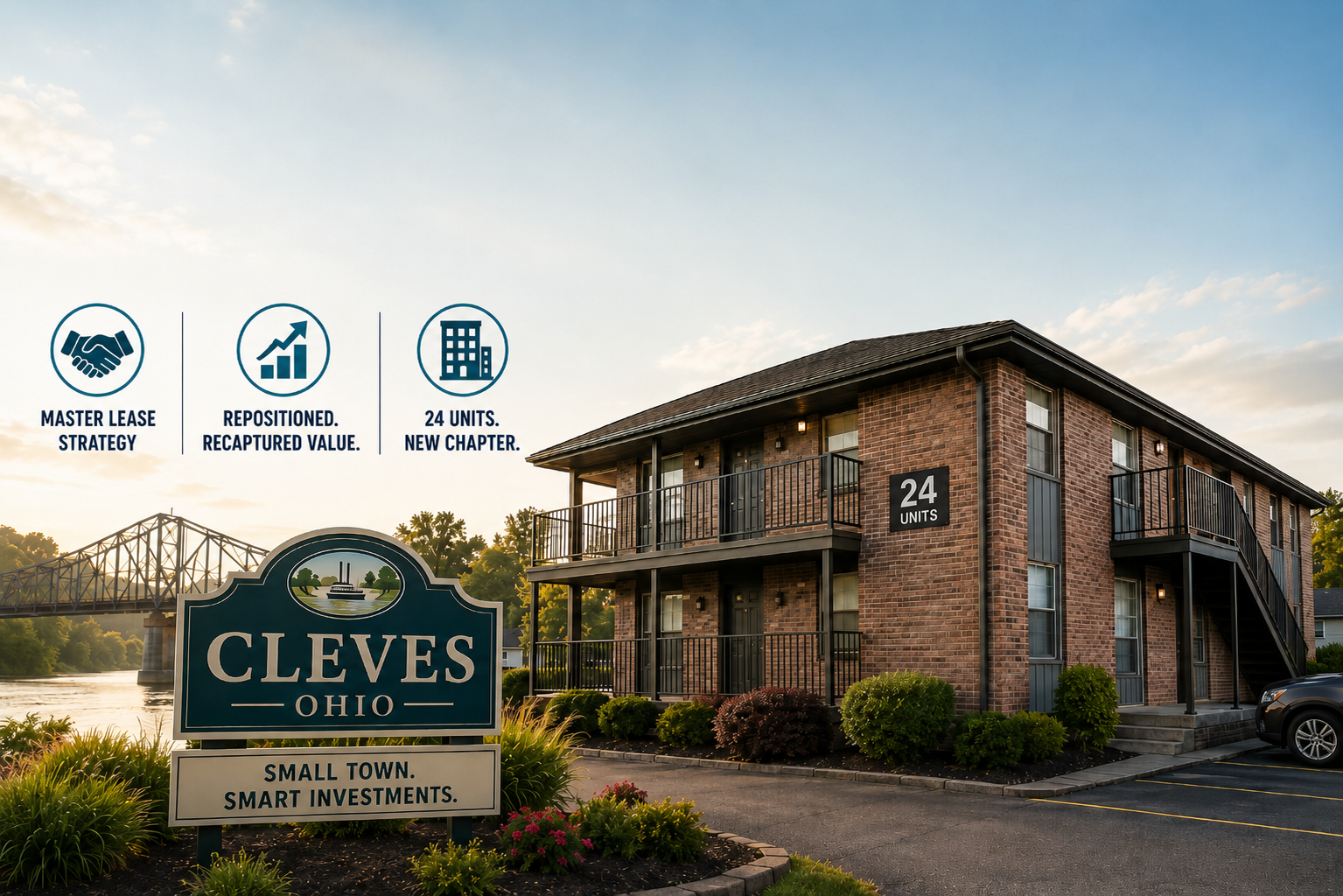
Nine of 24 units were paying rent. Slocomb Reed took over management three months before closing, cleared the building, and proved higher rents; all before owning a share of it.
August 27, 2026
Reading, Ohio: Cincinnati's Unlikely Development Hotspot
August 26, 2026
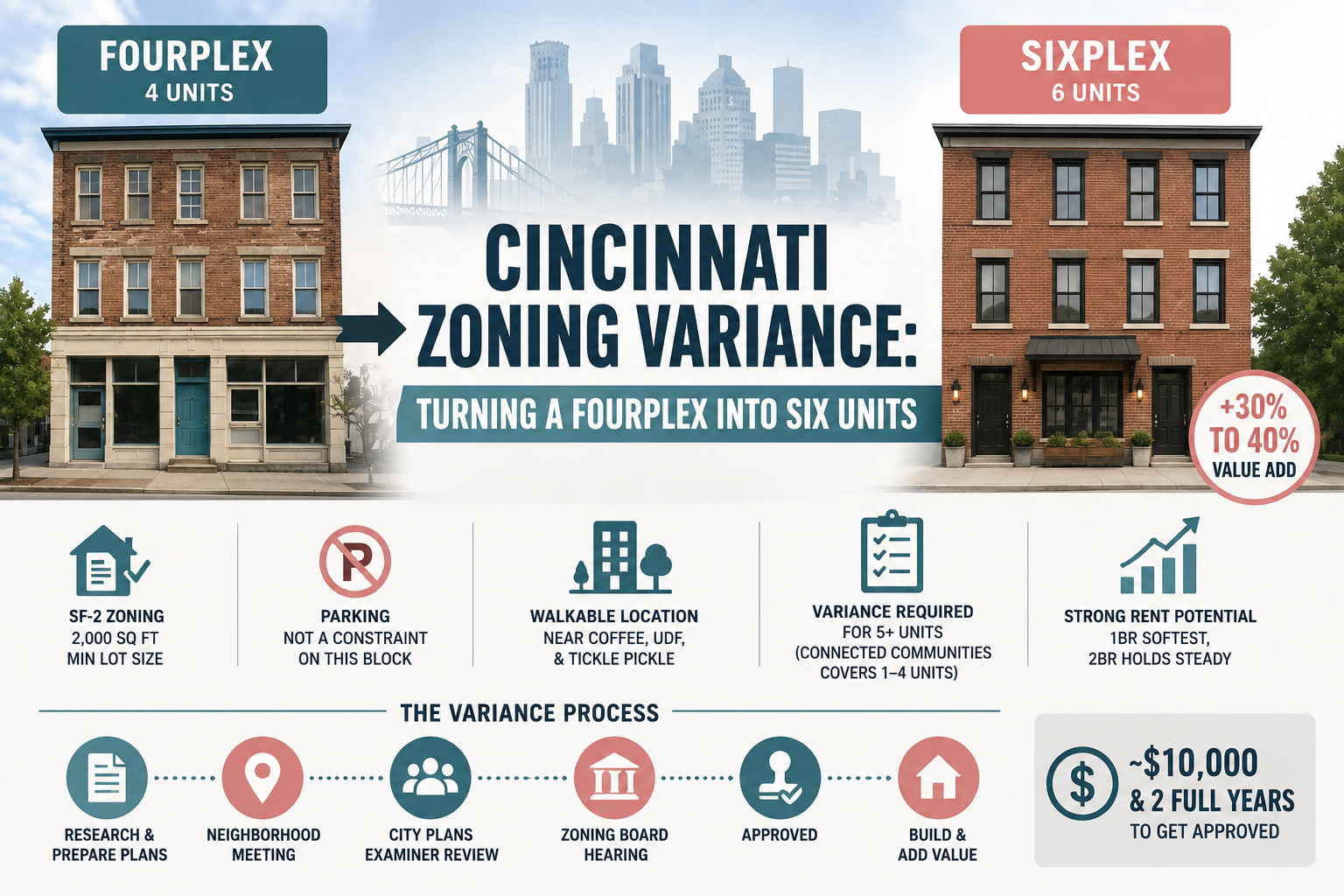
Two years, roughly $10,000 in zoning costs, and about 40 neighbor signatures. What Jeremy Komer's Northside conversion reveals about Cincinnati's variance process and the gap in Connected Communities.
August 25, 2026
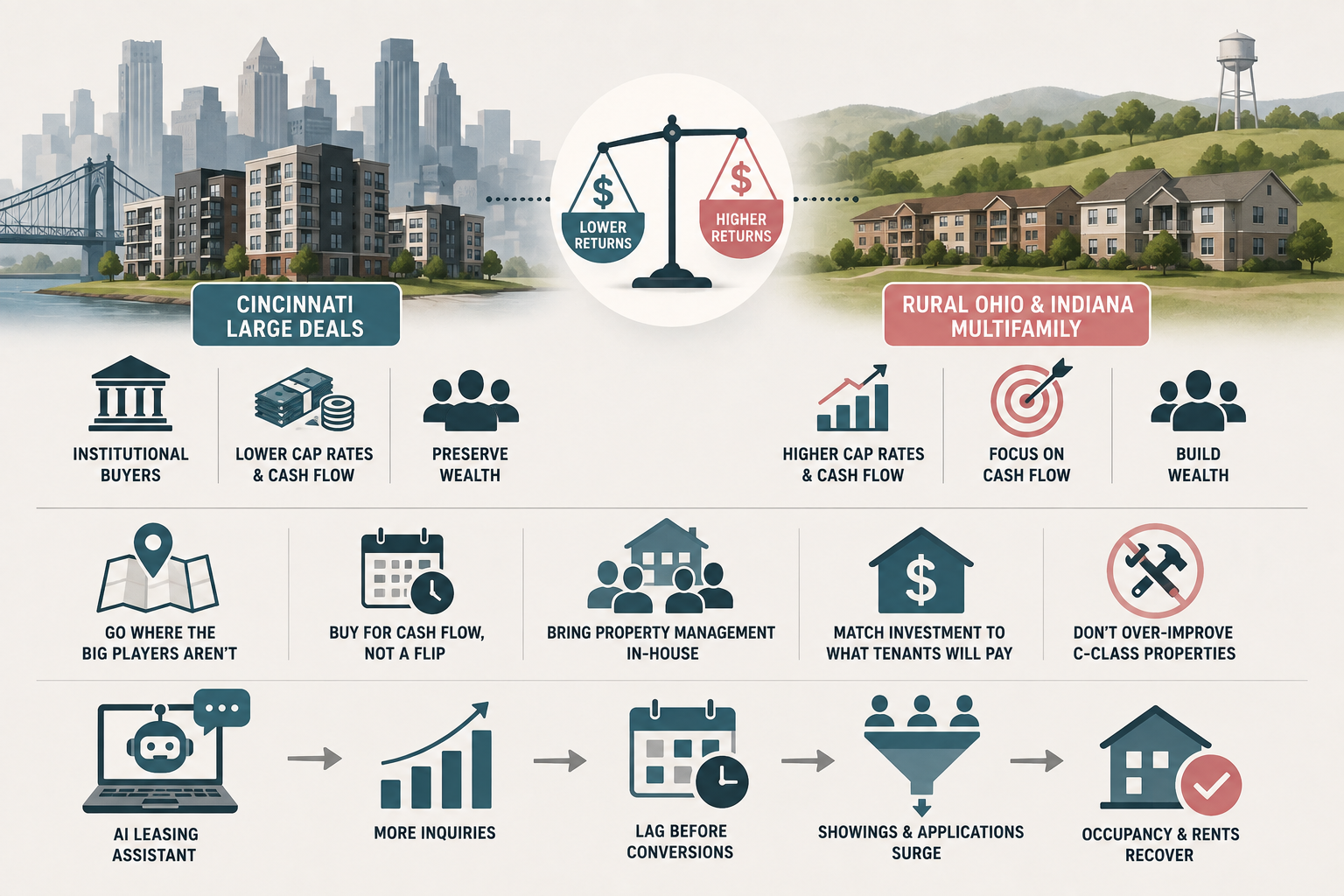
Lee Yoder holds 930 units, and almost none of them are near Cincinnati. Why institutional capital compresses returns above 100 units, and what he found in rural Ohio and Indiana instead.
By Ian Cruz August 20, 2026
How Ian Cruz and Slocomb Reed used four defined roles to scale from an 8-unit Northside deal to 73 units in under two years — plus what Cincinnati's rental data shows right now.