

Short-Term Rentals in Cincinnati: Where They Still Work in 2026

A neighborhood-by-neighborhood map of where short-term rentals are legal in Greater Cincinnati; and what the flattening market means for the ones that are.

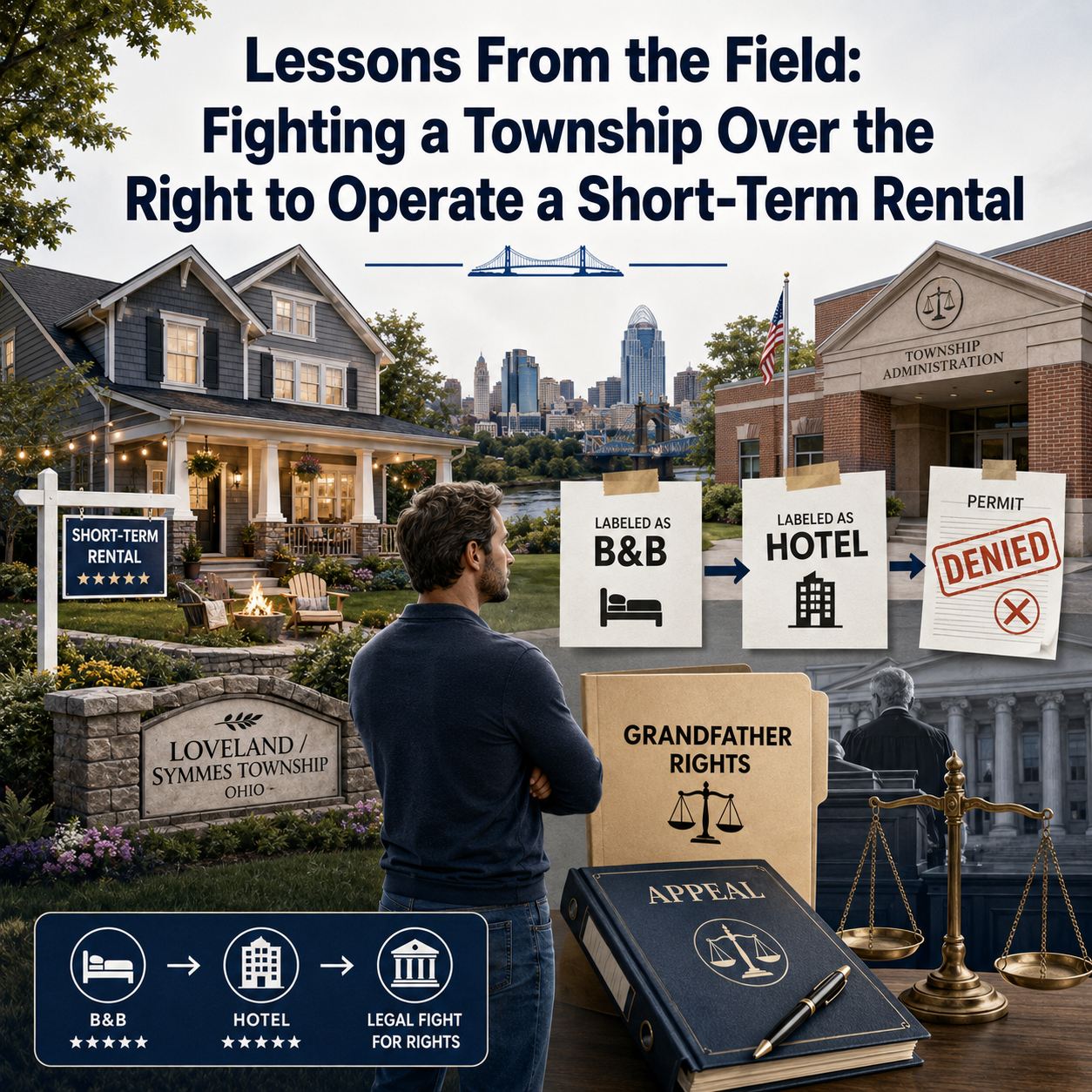
In Symmes Township, three short-term rental owners had to fight all the way to the Ohio First District Court of Appeals just to keep operating, after the township first tried to reclassify their properties as a bed and breakfast, then as a hotel, to shut them down. Yiwei Cheng, founder of Pink Cash Cow Property Management, has managed around 30 furnished rental properties across Greater Cincinnati since 2019, and her portfolio has lived through nearly every version of that regulatory fight, along with the shift in what actually books in 2026.

About This Post

This analysis draws from a conversation with Yiwei Cheng, founder of Pink Cash Cow Property Management, who has managed around 30 short-term and midterm rental properties across Greater Cincinnati since 2019 and set up more than 40 over the years. Her combination of ownership, arbitrage, and third-party management experience gives her visibility into performance data and regulatory outcomes across neighborhoods that a single-property owner would not have.

Listen to the full conversation on Spotify, Apple Podcasts, and YouTube. The full episode also covers Cheng's early mistakes pricing her first Airbnb and a full breakdown of Cincinnati's biggest annual events by booking demand.

The Cincy REI Show publishes every Monday. New episodes cover neighborhood-level analysis, local investor strategies, and real deal stories from operators active in Greater Cincinnati.

Where Short-Term Rentals Are Still Legal and Working in Greater Cincinnati

  • The City of Cincinnati is the safest legal ground in the region. Short-term rentals are written directly into city law, so an owner who registers and pays the required taxes is protected regardless of neighborhood. Downtown and OTR condos slowed hard during COVID but have since become part of a broader mix rather than the whole strategy.
  • Mount Auburn is where Cheng bought her own first home, drawn by a tax abatement and proximity to downtown. It sits near Oakley and Hyde Park without carrying the single-bathroom housing stock that made those two neighborhoods a harder fit for her.
  • Oakley and Hyde Park carry a lot of older housing with only one bathroom, which Cheng now actively avoids when sourcing STR properties, regardless of neighborhood desirability.
  • Norwood illustrates just how much the numbers have moved. In 2018 and 2019, an $80,000 house there rented for around $500 a month, barely cash flowing on a 30-year mortgage. As a furnished rental today, a one-bedroom in Norwood was getting $1,700 a month on midterm stays and is now booking closer to $1,500, still well above what it would produce as a standard long-term rental.
  • Loveland allows short-term rentals outright and has a real cluster of them near the Loveland bike trail.
  • Symmes Township, next door to Loveland, does not allow new short-term rentals. A neighbor's complaint led the township to try reclassifying an existing property as a bed and breakfast, then a hotel, before passing a new ordinance within two months that created a permit pathway while publicly stating it would deny every permit filed under it.
  • West Chester Township and Liberty Township each had hundreds of short-term rentals operating before both put moratoriums in place within the last year, banning any new ones going forward.
  • Blue Ash, Terrace Park, and Mariemont ban short-term rentals outright.
  • Covington, Kentucky allows short-term rentals, but requires three separate licenses (occupational, rental, and a short-term rental application), inspections, and a minimum distance between properties, making it a heavier lift to set up than most Ohio-side markets.
  • Newport, Kentucky technically allows short-term rentals in one zoning district, but that district has so little residential housing stock that it is not a realistic option for most investors.
  • Bellevue, Kentucky allows short-term rentals only if the property is the owner's primary residence, with a cap on the number of rental days per year.
  • The City of Hamilton allows short-term rentals with a license, though Cheng notes guest quality there has been inconsistent. Midterm rentals are performing well in Hamilton, driven by people displaced by fire or flood and by construction workers, and Cheng is watching a proposed data center project there that, if approved, could significantly increase midterm demand from construction crews. The townships surrounding the city of Hamilton do not allow overnight stays at all, which is part of why Spooky Nook-driven demand pushes toward the city proper.
  • Mason allows short-term rentals with a permit, though Cheng's own property sits in the unincorporated township next to Mason, which currently has no regulation against it. That property has run successfully since 2021, benefiting from relocation demand and the annual Cincinnati Open tennis tournament, historically the single biggest short-term rental month in the entire region, not just Mason.

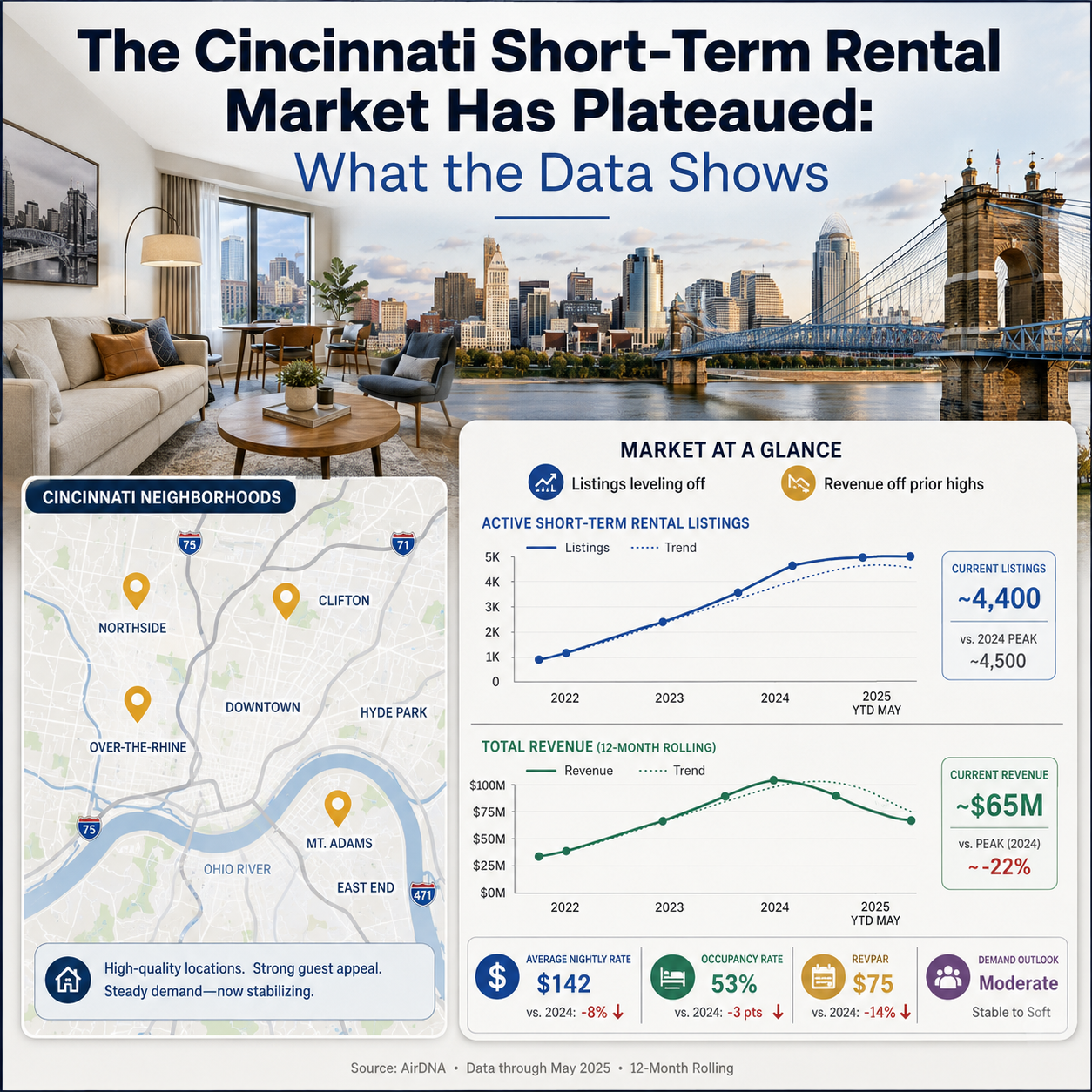
The Cincinnati Short-Term Rental Market Has Plateaued: What the Data Shows

According to AirDNA, Greater Cincinnati now has roughly 3,000 active short-term rental listings, with supply up only 0.4% year over year, which Cheng describes as essentially flat. Peak listing counts moved from 3,319 in July 2023, to 3,583 in mid-2024, to 3,690 more recently. Listings roughly doubled during the 2022 to 2024 stretch and have since leveled off.


Rates have moved in the opposite direction from where owners got used to during 2021 to 2023. Cheng points to two-bedroom, one-bath properties that used to generate $4,500 a month in revenue now producing closer to $3,000. Traveling nurse demand, which spiked hard during COVID with elevated per diem stipends, has dropped sharply, with Cheng now booking roughly one traveling nurse a year on inventory that used to stay full with them.


For an investor evaluating Cincinnati real estate for furnished rentals, the implication is straightforward: the easy-money phase of 2021 to 2023 is over, and the properties that still perform well are the ones matched carefully to location, layout, and a realistic read of current rates, not the ones bought on the assumption that any furnished listing will outperform a long-term rental.

What's Working in Cincinnati

Cheng's screening criteria for a furnished rental property in Greater Cincinnati comes down to three property traits.

  1. A minimum of two full bathrooms. Cheng is direct that a single-bathroom property, common in older Oakley and Hyde Park housing stock, does not perform in 2026 even when priced competitively.
  2. A workable bedroom-to-bathroom ratio. A five-bedroom, one-and-a-half-bath layout, the kind created by finishing an attic into extra bedrooms without adding plumbing, sounds like more inventory but functions poorly once ten guests are sharing one full bathroom.
  3. No walk-through bedrooms. Any layout where a guest has to pass through one bedroom to reach another kills the privacy that furnished rental guests expect, regardless of how the listing counts total bedrooms.

Amenities matter in a specific order, based on what Cheng has seen drive bookings.

  1. Parking, ranked as the single most important amenity. Garage parking beats driveway parking, which beats street parking, and this matters most downtown, where some zoning does not even allow street parking for guests.
  2. A pool, which Cheng says reliably justifies its added expense through higher revenue.
  3. A hot tub, which increases revenue but comes with enough ongoing maintenance, draining, cleaning, and pH balancing between every guest, that Cheng has chosen not to offer one herself.
  4. Family-friendly amenities, like a crib or high chair, which Cheng sources cheaply through Facebook Marketplace and includes automatically in larger homes to capture family travel demand.

The seasonal playbook Cheng runs is to raise nightly rates as high as the market allows during peak season, then shift the same property toward 30-plus day midterm stays in the off-season to protect occupancy without racing rates to the bottom. She holds a firm rate floor rather than chasing every winter booking, because she has found that guests who push hardest for discounts upfront are also the guests most likely to leave problem reviews or attempt chargebacks.

What is not working: buying based on the assumption that any location or layout will succeed as a short-term rental. Cheng is specific that success now requires matching property type to location and to the realistic current rate environment, not the 2021-to-2023 pricing many owners are still anchored to.

Lessons From the Field: Fighting a Township Over the Right to Operate a Short-Term Rental

Cheng and two other owners were running short-term rentals in Symmes Township, near Loveland, when a retired neighbor began complaining to local officials that the properties did not belong in the area. The township responded by attempting to classify Cheng's property as a bed and breakfast under an ordinance that predated short-term rentals entirely.


Cheng retained a zoning attorney and appealed, showing that the property did not meet the legal definition of a bed and breakfast. The township's next move was to reclassify the same property as a hotel instead, another category the property clearly did not fit, but one the township used regardless to justify denying operation.


Cheng appealed again, this time to the Hamilton County Court of Appeals, and lost. During that same period, the township passed a new ordinance in just two months, one that technically allowed short-term rentals through a variance permit process while stating publicly that every permit application would be denied. The case then became a fight over whether Cheng's property, operating before the new ordinance existed, should be grandfathered in.

Cheng and her co-plaintiffs took the case one level higher, to the First District Court of Appeals overseeing Hamilton County, and won. The outcome protects the three specific properties involved in the lawsuit, but it does not open the door for any new short-term rental to start operating in Symmes Township going forward.

  1. A single neighbor complaint can trigger a multi-year legal fight. The entire case originated from one retired resident objecting to who was coming and going next door.
  2. Municipalities can shift legal theories mid-fight. Symmes Township moved from a bed and breakfast classification to a hotel classification once the first did not hold up.
  3. Winning grandfathered status does not create new opportunity. The court victory protected existing operators only. It did not make Symmes Township viable for new short-term rental purchases.
  4. A fast-moving ordinance change is a warning sign, not a resolution. The two-month ordinance passage that promised to deny every permit was a tactic, not a genuine compliance pathway.
  5. Joining forces with other affected owners strengthens a legal case. Cheng's lawsuit succeeded as a group of three owners rather than a single property fighting alone.
September 4, 2026
The Hamilton County timeline from a missed rent payment to a set-out; and why TLP's Izzy Ong treats every case that reaches a magistrate as a failure of the process, not a win.
September 3, 2026
A $450,000 Loveland listing sold for $570,000 cash. Ethan Bishop on which Greater Cincinnati submarkets are drawing multiple offers, which have quietly cooled, and the two-generation demand pattern driving both.
September 2, 2026
Off-street parking, galvanized plumbing, school district lines that don't follow township borders, and a tax bill that can quadruple at closing. The Cincinnati-specific due diligence most investors skip.
August 31, 2026
JD Schmerge brokers Greater Cincinnati multifamily and operates a 7-unit in South Covington. Why tenants aren't paying for upgraded finishes, why insurance and taxes now outweigh interest rates, and how much to renovate before selling.
August 28, 2026
Bret Halsey went from pro soccer to 70-plus units in under three years, 14 of them fourplexes. How Cincinnati's repeating 1960s floor plans make the city's most common multifamily building the easiest one to underwrite.
August 27, 2026
Nine of 24 units were paying rent. Slocomb Reed took over management three months before closing, cleared the building, and proved higher rents; all before owning a share of it.
August 27, 2026
Reading, Ohio: Cincinnati's Unlikely Development Hotspot
August 26, 2026
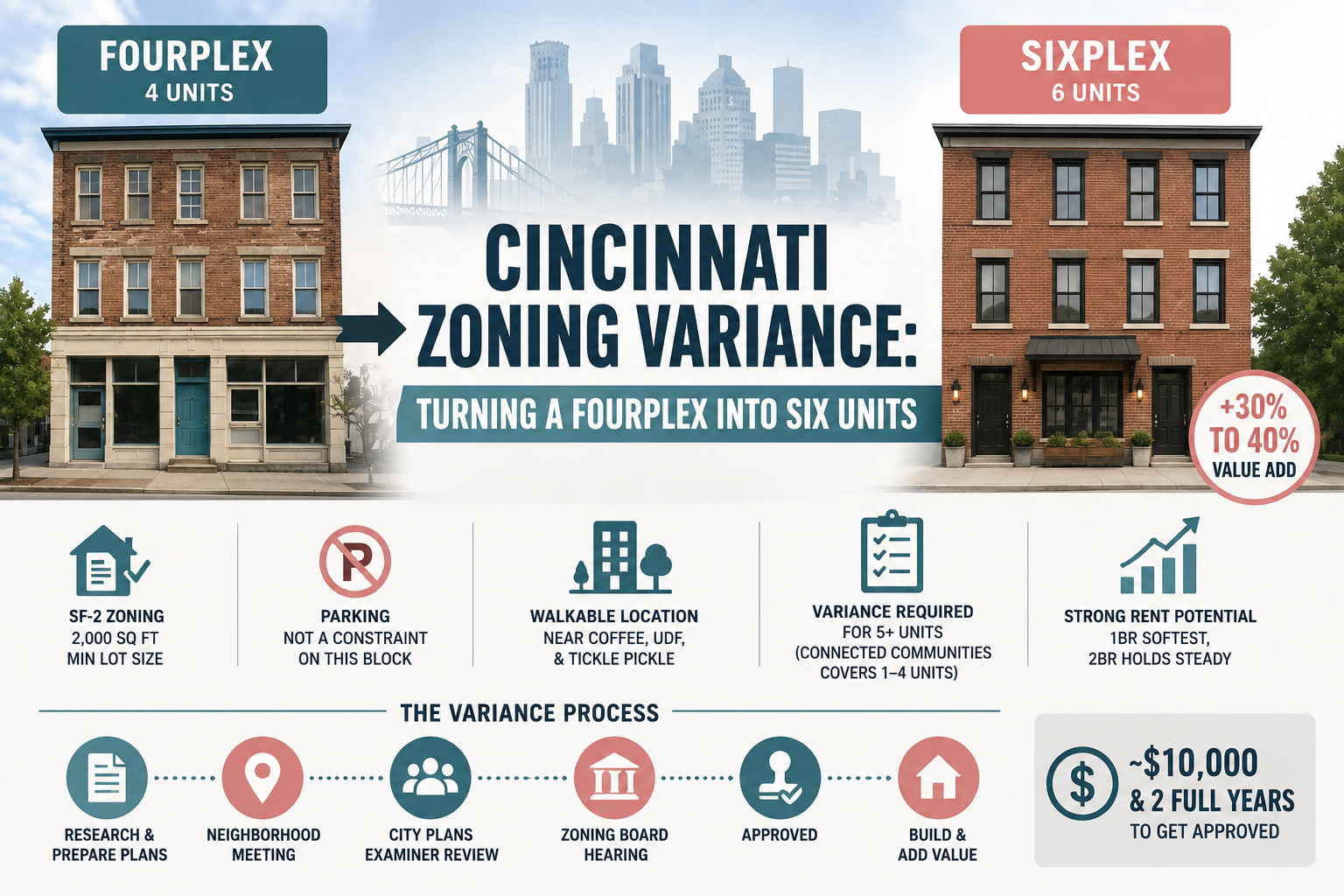
Two years, roughly $10,000 in zoning costs, and about 40 neighbor signatures. What Jeremy Komer's Northside conversion reveals about Cincinnati's variance process and the gap in Connected Communities.
August 25, 2026
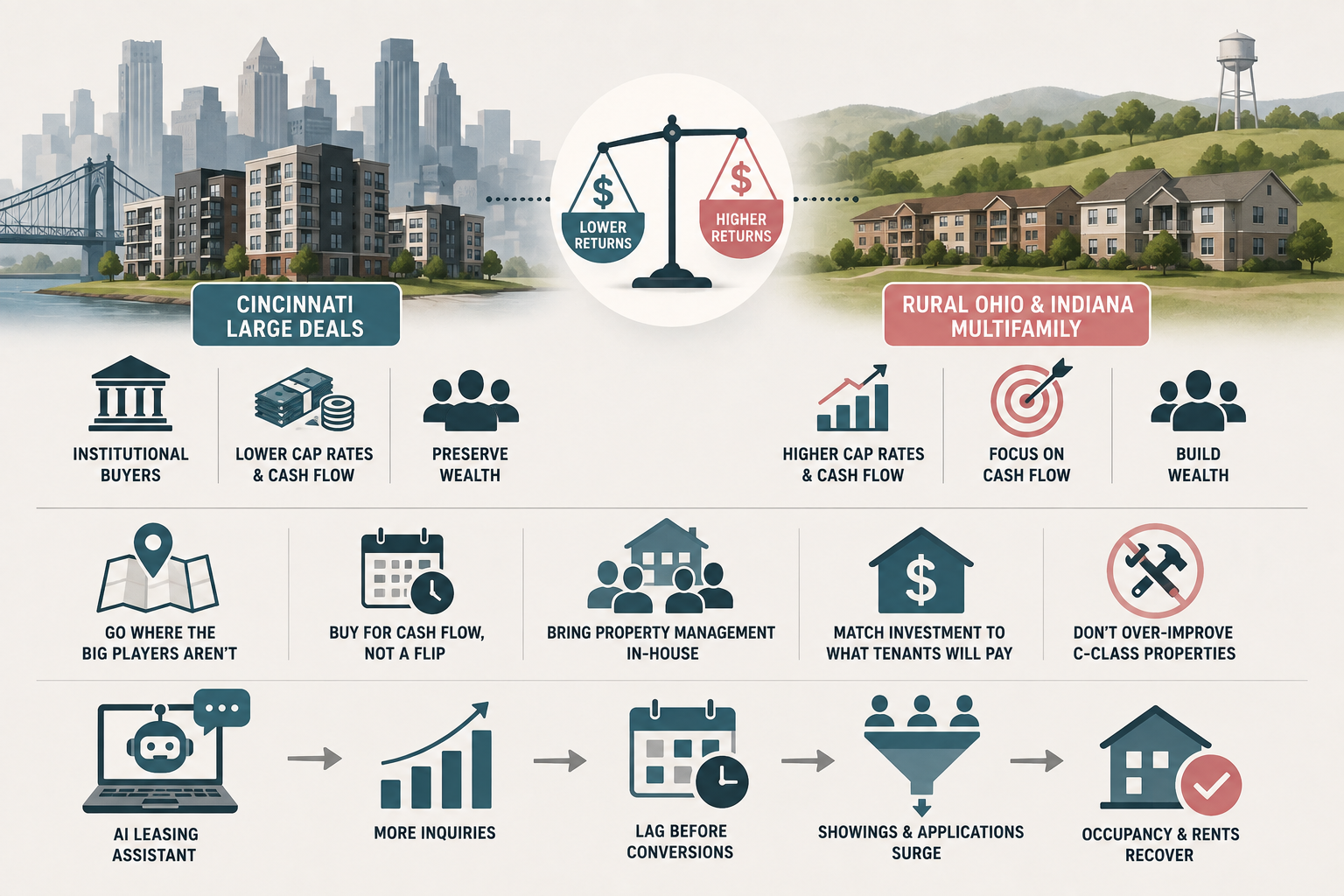
Lee Yoder holds 930 units, and almost none of them are near Cincinnati. Why institutional capital compresses returns above 100 units, and what he found in rural Ohio and Indiana instead.
By Ian Cruz August 20, 2026
How Ian Cruz and Slocomb Reed used four defined roles to scale from an 8-unit Northside deal to 73 units in under two years — plus what Cincinnati's rental data shows right now.