Self-Manage or Hire a PM? A Cincinnati Broker's Rental Math
Self-manage if you're trying to save money. Hire out if you're trying to save time. Bri Leichliter built a Cincinnati property management company, sold it, and still owns five units — here's the math behind that split.
Bri Leichliter, a Realtor licensed in Ohio and Kentucky, signed her first Cincinnati property management client in April 2021, built an independent brokerage around that business, and sold it in October 2025. She still manages construction for those former clients, consults brokerages on property management systems, and owns five rental units across Westwood, White Oak, North College Hill, and Dayton, Ohio. That mix gives her a working view of Cincinnati real estate from the owner, manager, and contractor side at once.

This analysis draws from a conversation with Bri Leichliter, Realtor (Ohio and Kentucky) and property management consultant. Leichliter's years running a PM company for mostly out-of-state owners, combined with her own house hacks and BRRR, give her direct visibility into what separates rentals that build wealth from rentals that drain it.
Listen to the full conversation on Spotify, Apple Podcasts, and YouTube. The full episode also covers her move from GE Aviation supply chain into real estate, and her plans to invest in 55+ and assisted living housing.
The Cincy REI Show publishes every Monday. New episodes cover neighborhood-level analysis, local investor strategies, and real deal stories from operators active in Greater Cincinnati.
Where to House Hack and Hold Small Multifamily in Greater Cincinnati
Every month of 2026, the MLS has shown cash-flow-positive single-family and small multifamily listings in Greater Cincinnati. Two-to-four-family buildings sit in nearly every neighborhood, so a house hack does not require moving to a low-income area.
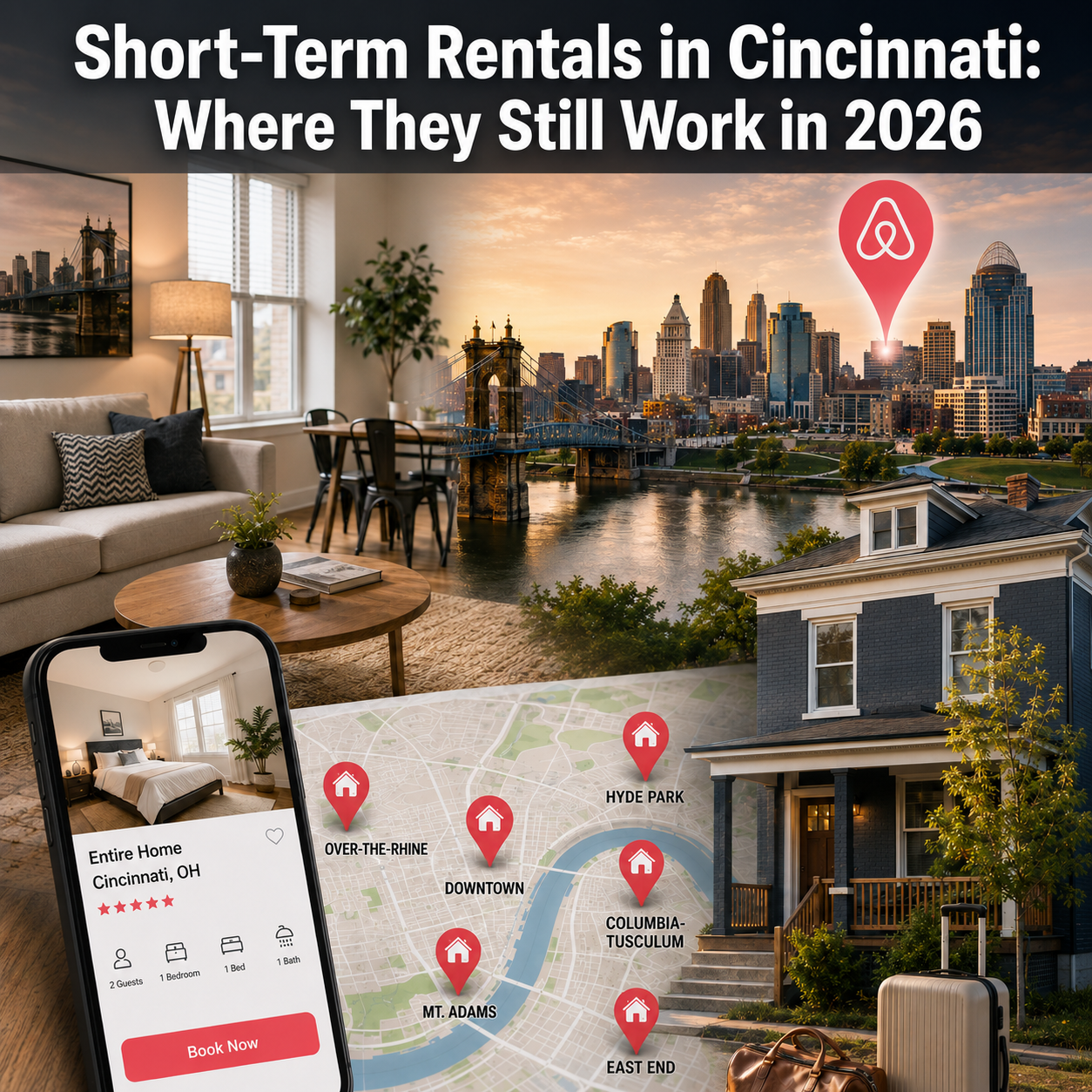
- Hyde Park, Oakley, Deer Park, and Amberley Village all carry small multifamily inventory in some of the highest-income parts of the region. Side-by-side units are rare, so expect a neighbor above or below you.
- Westwood has strong small multifamily pockets, and location on its long cross streets matters. Leichliter's four-unit sits on Westwood Northern Boulevard north of Montana, near the Mount Airy dog park. Westwood Northern, Harrison Avenue, and Glenway cut through so many neighborhoods that the block matters as much as the street.
- Mount Washington was her first house hack, a duplex bought directly from the seller off Craigslist in 2019 with a conventional loan.
- Northside was her second house hack, a duplex on Jerome. She sold both house hacks as a capital play and kept every property she bought as a rental.
- North College Hill holds her single-family BRRR. She bought with hard money, placed a tenant, and refinanced. The same tenant has stayed three years.
- White Oak is where she bought her first single-family home, which she still owns.
- Northern Kentucky has small multifamily in some of its best areas, including a four-family in Devou Park that Slocomb Reed's company manages. Prices and rents run lower than the Ohio side.
Why One Rental Rarely Builds Wealth in the Cincinnati Real Estate Market
A rental that nets $100 a month loses five years of cash flow to one furnace. Leichliter's position is direct: a single rental property is not making anybody rich, and after real expenses many single-property owners are paying into it every month.
Rental wealth comes from scale and appreciation. Some of her PM clients ignored cash flow entirely and bought for appreciation and tax strategy. Most were out of state, many on the West Coast, drawn by Midwest price points and rents. Several had self-managed for years using a trusted local handyman as their eyes on the ground.
Her framework for who should self-manage:
- Self-manage if your goal is saving money. Local investors with flip experience, trade skills, or contractor relationships hold an edge over someone who inherited a house.
- Hire a property manager if your goal is saving time. Owners who earn hundreds of dollars an hour should spend those hours earning, and a strong PM passes along contractor volume discounts.
- Plan for the ceiling. Self-management caps out at the number of doors one person can run, unless you build an internal operations team.
- Consider passive equity. Some investors belong in real estate syndication as limited partners. Professional operators budget CapEx reserves and risk, which raises the floor on returns.
House hacking gets judged by the wrong metric. A successful house hack reduces your personal housing cost, even if the property would never cash flow as a standalone rental. A Hyde Park owner who would pay $4,000 to $5,000 a month and drops to $2,000 out of pocket has a working house hack.
What's Working in Cincinnati
| Strategy | Best Fit | Key Underwriting Focus |
|---|---|---|
| House hacking | Two-to-four-family in Hyde Park, Oakley, Deer Park, Northside, Westwood, Devou Park | Housing cost reduction, unit layout, resale path |
| Buy-and-hold multifamily | 5 to 10+ unit buildings | Central location, vacancy exposure, CapEx reserves |
| BRRR single-family | North College Hill, White Oak | Hard money terms, rehab scope, refinance appraisal, tenant retention |
| Section 8 and 55+ housing | Affordable and aging-population demand | Program knowledge, operating structure, long-term demand |
Leichliter's buy box has moved to five units minimum, more likely 10 and up. One vacancy in a single-family turns the asset into a liability. Multiple units in one location spread that risk.
On rehabs, she runs three rules:
- Write a full scope before work starts. Hand contractors your own checklist so nothing inside or outside the unit is skipped. Budget creep comes from add-ons the original scope missed.
- Open the walls behind new finishes. If new cabinets or a shower surround are going in, check the plumbing stack first. Pre-1978 homes, 1920s Cape Cods with knob-and-tube, and galvanized steel lines carry the most risk.
- Scope every sewer line. A sewer scope runs about $350. A recent replacement quote she received came in above $30,000. Remodeled homes can still tie into clay pipe.
The same discipline applies at acquisition. During due diligence on a large scattered-site portfolio purchase, Slocomb and Ian's maintenance technicians ran the inspections. Some sewer lines could not be scoped, and March weather ruled out testing older AC equipment. The underwriting assigned a failure rate to each risk and budgeted a dollar amount per item.
Lessons From the Field: Whoever Controls the Money Controls the Project
After the sale closed, Leichliter kept managing construction for former PM clients. A new fiduciary controlled the client funds, and she had no access to payments.
Contractors finished work and waited. Late payments triggered stop-work orders and walk-offs on other projects. Clients with no connection to the delay absorbed the fallout.
Her fix was a one-strike rule. If a contractor is paid late once after a completed, walked job, the client pays contractors directly from then on.
- Buy your own materials. Give contractors access to your Home Depot Pro account and approve purchases. Order fixtures yourself to control finish level.
- Skip the 50% deposit when you supply materials. Tie draws to completed work, agreed in writing, and walk the job before final payment.
- Pay 50% up front for roofing, foundation, and HVAC. On HVAC, equipment often exceeds half the job cost.
- Keep the money available before work starts. Slow pay burns through good contractors, and the next job gets harder to staff.