How to Research the Cincinnati Market in Two Hours a Week
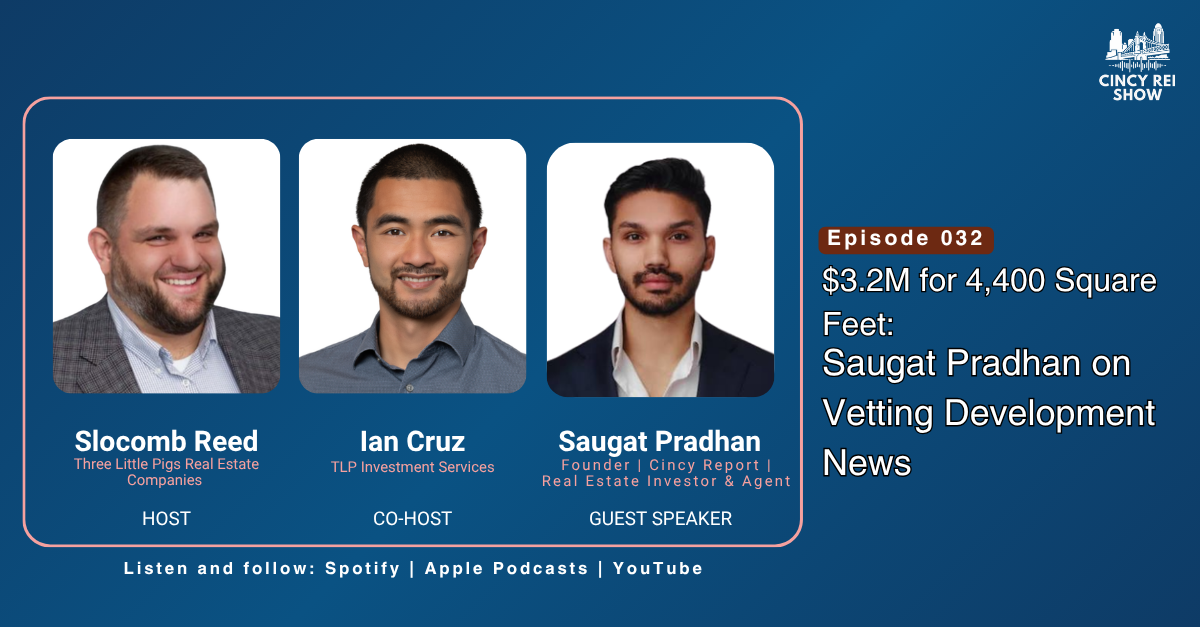
Saugat Pradhan started Cincy Report three months ago, before he had even moved to Cincinnati. It is approaching 20,000 followers and reaches more than 1.5 million viewers a month. His routine hasn't changed since day one: wake up, research what is happening in Cincinnati, verify it, and post a reel. Co-host Ian Cruz runs a similar routine from San Jose, California. Together they laid out how an investor can track Greater Cincinnati in two hours a week or less and where AI helps or hurts.
About This Post
This analysis draws from a conversation with
Saugat Pradhan, founder of Cincy Report, and co-host
Ian Cruz of Three Little Pigs Investment Services. Pradhan has four years of experience in residential, small multifamily and wholesale real estate. He moved to Cincinnati this month from South Dakota and is launching as an investor and agent. Cruz tracks Cincinnati development news as @cincycashflow and uses it to underwrite acquisitions from out of state.
Listen to the full conversation on
Spotify,
Apple Podcasts, and
YouTube. The full episode also covers how Pradhan uses Claude to analyze which Cincy Report posts perform best.
The Cincy REI Show publishes every Monday. New episodes cover neighborhood-level analysis, local investor strategies, and real deal stories from operators active in Greater Cincinnati.
Neighborhood Signals Worth Tracking in Greater Cincinnati Right Now
Neighborhood Facebook groups often break local news before the Business Journal does. Some of the projects and issues investors should be watching:
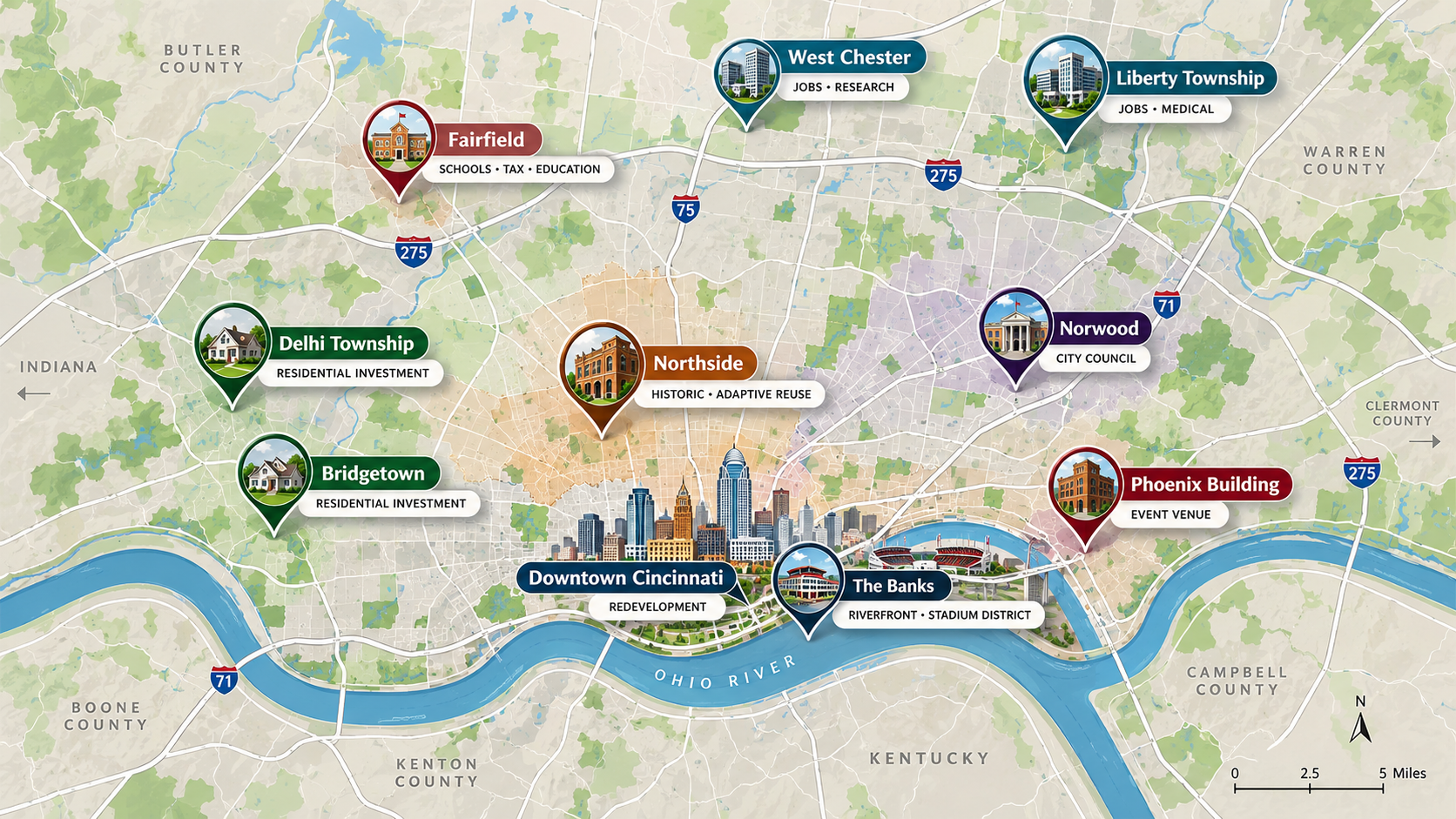
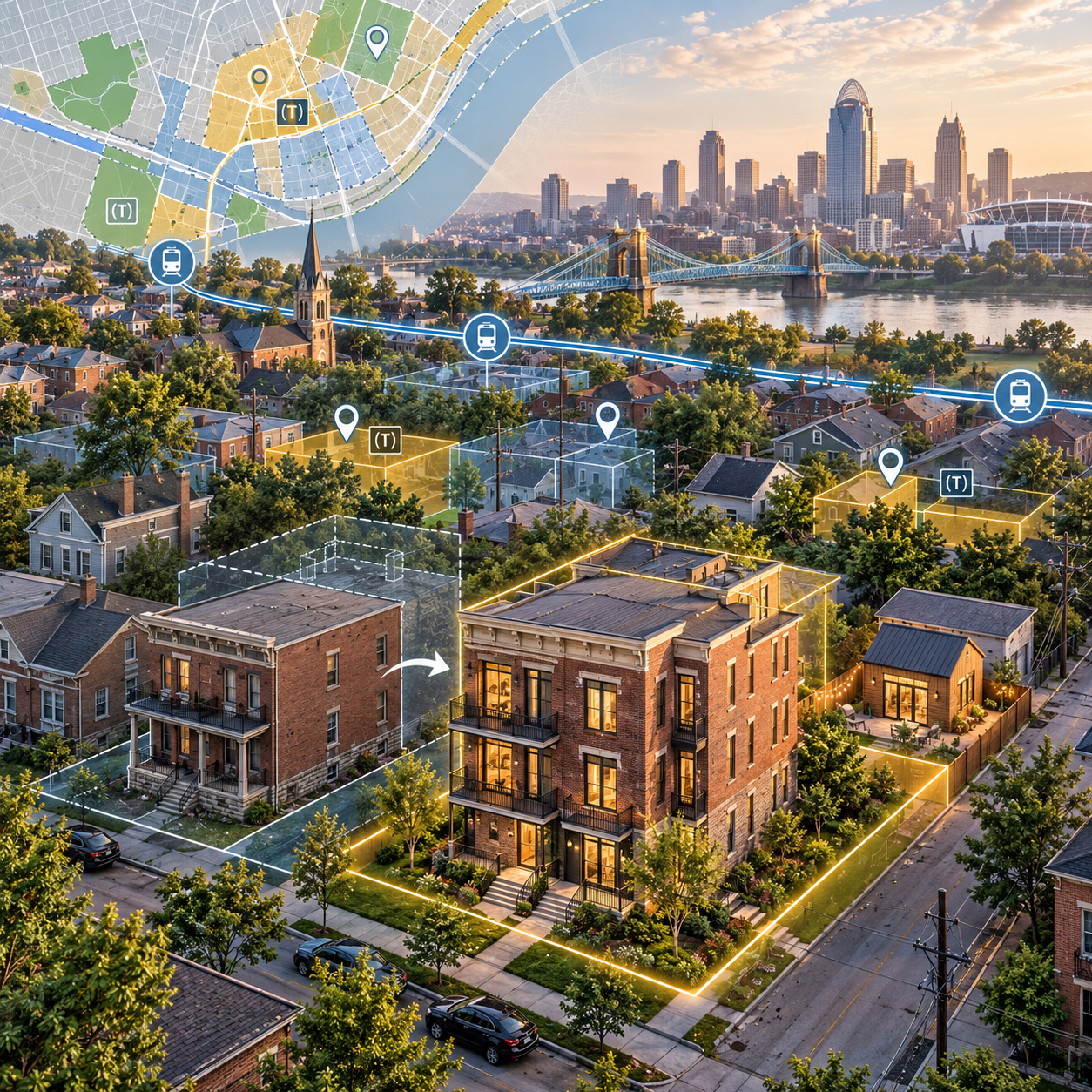
- Northside has two adaptive-reuse projects in motion. The developer of
Kirby School Apartments, a former school converted to housing, has applied to build new units next door. Cruz first saw it in the Northside Facebook group, where neighbors were debating it, before it appeared in the Business Journal. At
4001 Hamilton Avenue, the old Stoll's Drug Store just landed $400,000 in Ohio historic tax credits.
- Fairfield is debating an earned income tax levy for its schools. If it fails, the district plans to cut 18 elementary art, music, and PE positions and 30 English learner tutor positions and to charge $800 for youth sports. For rental owners, a school district's funding fights affect demand for three-bedroom-plus homes. Cruz follows this closely because Three Little Pigs owns property in Fairfield.
- Norwood posts its city council meetings on YouTube. Cruz pulls the transcripts and has Claude summarize them into bullet points, which is the quickest way to track council decisions in any suburb that records its meetings.
- Delhi Township and
Bridgetown in
Oak Hills Schools draw investors who buy only there. Host Slocomb Reed strongly recommends Delhi for single-family and small multifamily given its recent development activity. Pradhan's advice for any single-area investor: also watch adjacent neighborhoods, since development next door changes demand in yours.
- Downtown has
The Banks, a $750 million to $800 million redevelopment that the city council has cleared a path for near the stadiums. The
Phoenix Building is being converted into an event venue scheduled to reopen early next year.
- Liberty Township and West Chester are getting a research and jobs hub at
Cincinnati Children's Liberty Campus. Pradhan expects it to lift housing demand across both.
Where Reliable Cincinnati Real Estate Information Comes From
Both researchers start from the same source. Sources ranked by how much they rely on them:
- Cincinnati Business Journal. It is the one paid source either of them uses. Cruz estimates a single-city subscription at under $10 a month, and he has the print edition mailed to California. Much local TV and newspaper coverage cites it.
- County auditors. Follow Hamilton County Auditor and Butler County Auditor Nancy Nix on Facebook. Ohio counties post preliminary reassessment values on different timelines, and the auditors publish updates in real time.
- County and city websites for official notices, permits, and zoning.
- Broker research. Colliers, CBRE, and other large brokerages post quarterly market reports on LinkedIn.
- Local media, including Local 12 and the Enquirer, for confirmation.
Cincy Beat is the source for events.
- Neighborhood Facebook groups and neighbor apps for early signals and resident reaction.
What to avoid:
- AI-generated local news sites. Pradhan found a Cincinnati development site near the top of Google whose stories turned out to be fabricated. The giveaways were AI-sounding phrasing and generated images in place of real photos.
- Reddit. It is full of opinions and has little verified information.
- Viral tax claims. Nancy Nix recently debunked a viral YouTube video claiming Congress had passed property tax savings for older homeowners, which told viewers to request a "senior homeowner tax review" from their auditor. No such law, form or program exists. People still called her office asking for it.
What's Working in Cincinnati
A research routine that fits in two hours a week:
- Scan the Business Journal once. Cruz scrapes new articles into a Notion database and reviews them in one sitting instead of checking the site three times a day.
- Use AI to find headlines, then verify each one yourself. Ask Claude or ChatGPT what is new in a neighborhood, then search each topic on Google and confirm it with a trusted source.
- Cross-check with an independent source. Pradhan looks for the same story from an outlet that isn't just repeating the Business Journal before he treats it as fact.
- Cite the source every time. Cruz credits the original publisher, whether Redfin, a county site or the Business Journal, so readers can check it.
- Join Facebook groups for the areas you own in, and watch how residents react to proposals that affect them.
- Let your feed do the work. Follow Cincinnati investors, brokers and podcasts on LinkedIn and Instagram, and within a few months much of the week's news reaches you without searching.
Where AI Helps and Where it Fails
- It helps with volume. AI can screen dozens of articles, summarize council transcripts and surface topics worth checking. Pradhan also has Claude analyze which of his posts perform best.
- It fails on currency. Most of the wrong answers Cruz gets from AI are outdated information presented as current.
- It fails on private data. AI can't tell you what a 1960s Class C 20-unit in Cincinnati sold for, since entity transfers often never become public record. It can't tell you how insurance renewals are actually trending either.
- It invents things. Narrow its search to the exact article or county site you trust, and require a link for every claim. Reed learned early to make ChatGPT cite its sources, and it starts linking once you ask.
What doesn't work: letting AI do the whole job. Every researcher on this episode uses it for the first pass and relies on their own judgment for the last.
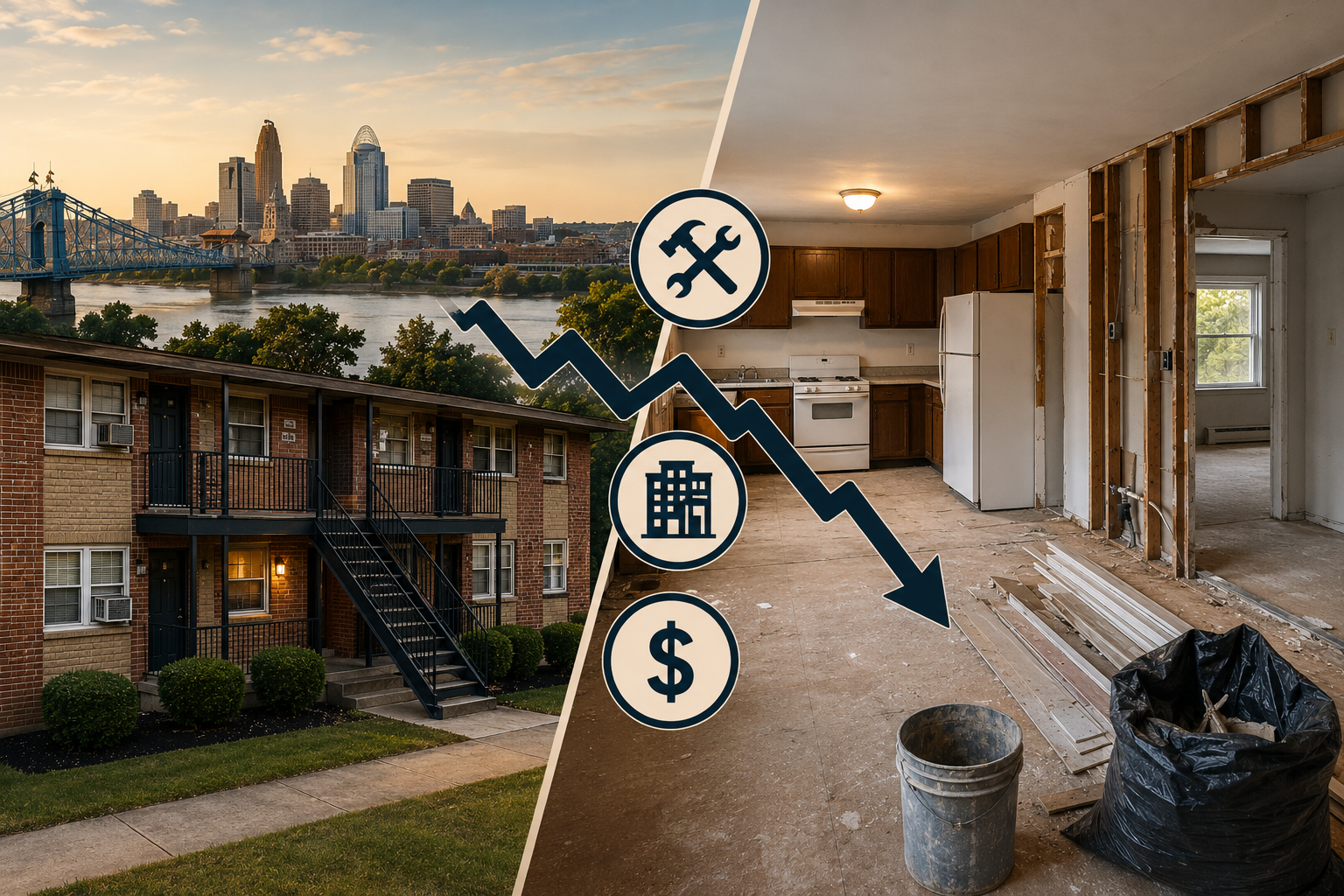
Lessons From the Field: Checking a $3.2 Million Northside Rehab
On air, Cruz brought up 4001 Hamilton Avenue in Northside, the old Stoll's Drug Store. His AI summary said a Northside redevelopment corporation bought the building for $190,000 in 2024 and planned $3.2 million of work to create first-floor retail with three or four apartments above.
Reed immediately suspected a hallucination. He pulled up the county auditor record. The entire building is 4,400 square feet, coded as retail with apartments over.
Cruz then checked the Business Journal. The figure was real: the project is estimated to cost $3.2 million.
Verified or not, the number deserved a second look. $3.2 million over 4,400 square feet is about $727 a square foot of renovation, which Reed estimates is roughly twice what new construction would cost. The project is being funded partly with $400,000 in historic tax credits.
- Verify every figure AI gives you. This one was true, and the next one might not be.
- Pull the auditor record. Square footage, land use and sale history turn a headline into a number you can test.
- Do the per-square-foot math. Mission-driven and tax-credit projects can pencil at costs no private investor could justify.
- Check the parcels next door. Land use codes show what a neighboring building can legally become.
- Treat good news as a signal, then underwrite it. A funded rehab tells you where money is flowing. It does not set your comps.