Five apartment deals over 100 units traded through June. Everything under 100 is closing at ask. Marianne Taylor on why Cincinnati’s distress comes from operations rather than bridge debt — and how to buy a bank-owned property at auction.
As of June, only five apartment deals over 100 units had traded in Cincinnati this year, and two of those were done directly between buyer and seller. Deals under 100 units are closing at the prices sellers expect. Meanwhile the five-year Treasury is back at its 2023 peak, and bank-owned apartment properties are starting to show up on auction platforms. Colliers multifamily broker Marianne Taylor says Cincinnati is at the beginning of a distress cycle the Sun Belt went through two years ago.
About This Post
This analysis draws from a conversation with
Marianne Taylor, vice president and multifamily broker at Colliers. Since starting in brokerage in October 2019, she has closed more than 80 deals totaling over $1.9 billion. Before that, she underwrote commercial real estate loans of every property type at PNC. She also teaches Property and Asset Management at the UC Lindner College of Business. Her team is currently running bank-owned auctions with Colliers' national distressed-asset group.
Listen to the full conversation on
Spotify,
Apple Podcasts, and
YouTube. The full episode also covers how she moved from bank branch sales to commercial underwriting to brokerage.
The Cincy REI Show publishes every Monday. New episodes cover neighborhood-level analysis, local investor strategies, and real deal stories from operators active in Greater Cincinnati.
Norwood, Madisonville, Downtown: Where Greater Cincinnati Changed Most Since 2019
Taylor has watched every Cincinnati submarket from the broker's seat since 2019. These are the areas she says have moved most, and where buyers are misreading the market.
- Downtown has seen the biggest income shift in the metro. Average household income rose from $41,000 in 2020 to $76,000 in 2025, an increase of about 85% in five years. Downtown apartment occupancy fell to between 80% and 85% during COVID. It has recovered enough to fuel a wave of office-to-apartment and office-to-hotel conversions, and top restaurants book out months ahead again.
- Norwood is, in Taylor's words, the new Oakley. She bought in the Presidential District in 2014, paying what she thought was the neighborhood's highest price, and the home is now worth close to double. The Wasson Way trail and Factory 52 have added walkable amenities.
- Madisonville followed Norwood. The Ackermann Group and PLK have built new multifamily there, retail has been redeveloped, and flippers are active.
- The City of Hamilton has a reputation among developers for approving projects. Spooky Nook anchors the growth, and the city's trail network adds to the appeal.
- Bike trails are a pattern across the metro. Growth keeps following the trail network in Norwood, Hamilton and Northern Kentucky, as residents pay to live near it.
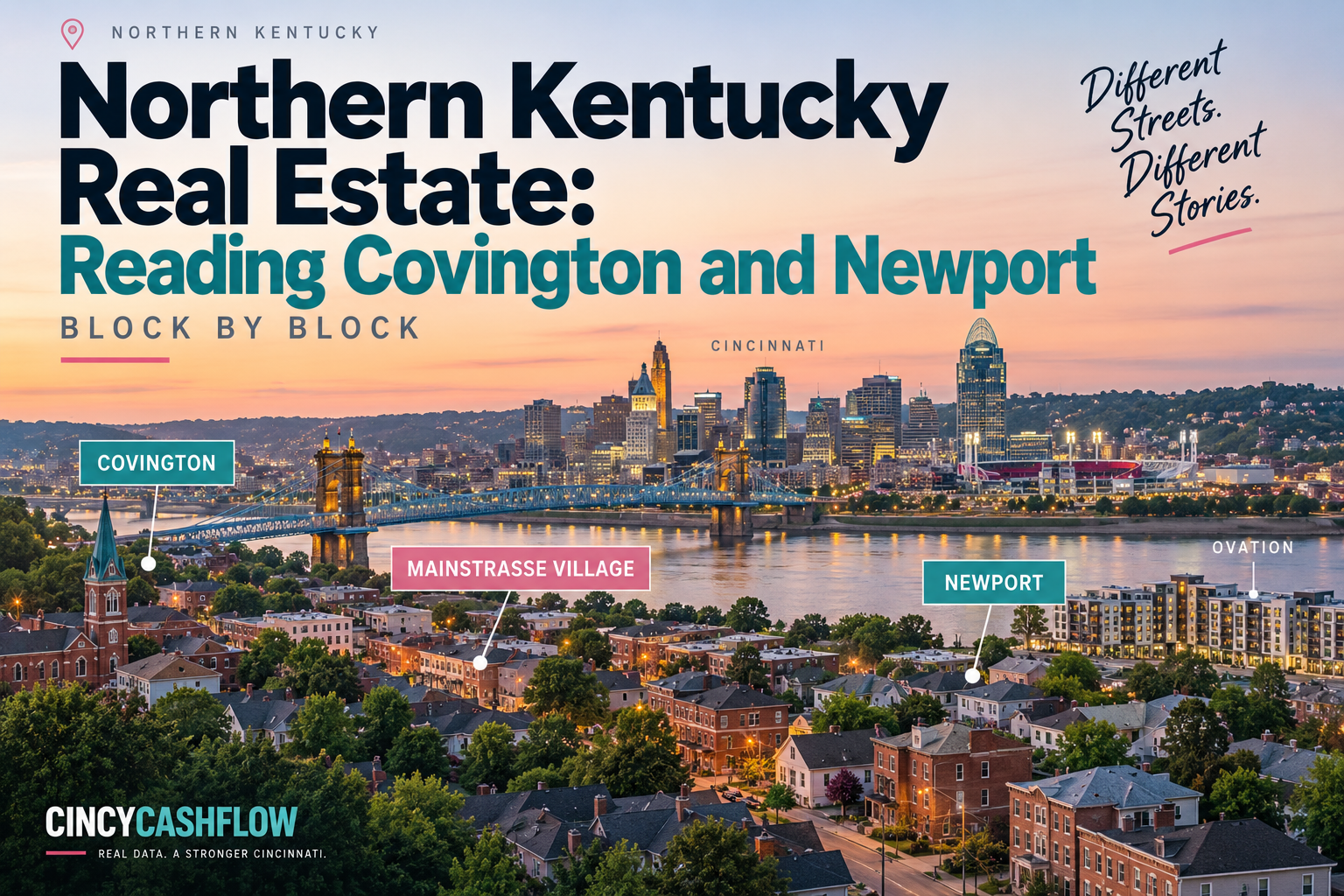
- Northern Kentucky is underrated in Taylor's view.
Covington,
Newport and
Bellevue are growing. Kentucky requires purchase price disclosure, so taxes reset predictably after a sale. In Ohio, entity transfers can make a property's future tax bill hard to predict.
- The West Side carries a reputation that shrinks the buyer pool. Some investors refuse to buy there at all. Its multifamily stock skews toward 1960s and 1970s construction, much like the rest of the market, with fewer 1990s-and-newer properties.
- Hyde Park, Oakley and Mount Lookout go the other way. On deals under about 25 units, Taylor sees buyers pay for location without checking whether the numbers work, betting on 10-year appreciation.
Why 2026 Became the Year of Small Multifamily Deals in Cincinnati
Taylor defines small deals as properties under 100 units. They have carried the Cincinnati real estate market this year.
- Large deals aren't trading. Only five properties over 100 units traded through June. Buyer feedback on the larger listings: priced too high, too far from what buyers will pay.
- Small deals are closing on price. Her team's underwriting on sub-100-unit listings has landed within sellers' expected ranges, and buyers are meeting it.
- Rates are climbing again. The five-year Treasury, which sets the base for most multifamily loan pricing, is back at its 2023 peak after rising steadily for several weeks. Rising rates push prices down, and they are ending the relative stability of 2024 and 2025.
- Distress is new here. Taylor started seeing distressed deals about two years ago. The volume is still small, and before that there was essentially none. Colliers' national distressed group says Fannie Mae, Freddie Mac and the large banks expect distressed sales to keep coming for the next few years.
What's Working in Cincinnati
How to buy a bank-owned apartment property at auction:
- Register on the platforms. The three that matter are
Crexi,
RI Marketplace (run by CWCapital) and
Ten-X (run by CoStar). Taylor's current listing, a 40-unit on Boudinot Avenue on the West Side that is 82% occupied, is running on Crexi.
- Get pre-qualified. Bidders submit a full application with proof of funds before they can bid.
- Do your diligence during marketing. Listings run for a month to six weeks. Buyers get every due diligence document up front.
- Use the tour days. Taylor's team hosts all-day tours, and buyers can come every day and bring inspectors and contractors. You won't see every unit. You will see the worst units, the vacants and any renovated units.
- Accept the contract as written. The purchase agreement is posted in advance and can't be negotiated. You agree to it before you bid.
- Know how bidding really works. Bidding runs for two days. Host Slocomb Reed says the real action happens in the last few minutes, as automatic bids run up to each bidder's maximum.
- Be ready to close in 30 days. The whole process takes two to two and a half months. A typical brokered sale takes four to six months.
Timing a listing. Many national multifamily buyers observe the Jewish holidays that fall through September, so Taylor avoids listing then. October works if the deal is under contract before Thanksgiving. Little lists from late November through December. January brings NMHC and freshly funded buyers, and it is the busiest season. Owners also ask for broker opinions of value right after year-end, once December 31 numbers are in.
Buying at a discount doesn't finish the job. Distressed properties will trade below market. The bigger lift is usually management: getting leasing, collections and staffing back in place, alongside whatever CapEx the property needs.
Budget for what you can't control. One of Taylor's UC guest speakers owns about 300 units. A tornado took the roof off one of his storage facilities. At another of his properties, a car left I-74, crossed a gully and landed in the second floor of an apartment building. Her lesson for students: you can plan and budget, and some events will still wreck the year's numbers.
Banks reward sticky clients. From Taylor's time in banking: lenders offer their best rates to borrowers who use more of their products, because those clients are less likely to leave.
What doesn't work: buying on location alone. Paying Hyde Park prices for a sub-25-unit building without checking the numbers is a bet on appreciation.
Lessons From the Field: How a Lima Apartment Complex Ended Up at Auction
Shortly after joining Colliers, Taylor launched her first auction: a roughly 125-unit apartment complex in Lima, Ohio, about two hours north of Cincinnati.
The owner had let operations slip until the property was 50% occupied. Then a fire hit the building.
Only then did the lender learn the owner had stopped paying for insurance. With major damage and no coverage, the owner couldn't pay for repairs, and the bank took the property back.
- Distress in Cincinnati starts with operations. Missed basics like insurance, leasing and maintenance turn a performing loan into a bank-owned asset.
- Verify your partners' numbers. Visit the property and compare the rent roll against bank deposits.
- Tour days are your inspection. Bring your contractor every day you can, and price the worst units you are shown.
- Price the turnaround, too. Filling the vacant half of a building takes new management, a leasing plan and capital.
- Get pre-qualified before a deal appears. Auction timelines leave no time to arrange financing after listing.